
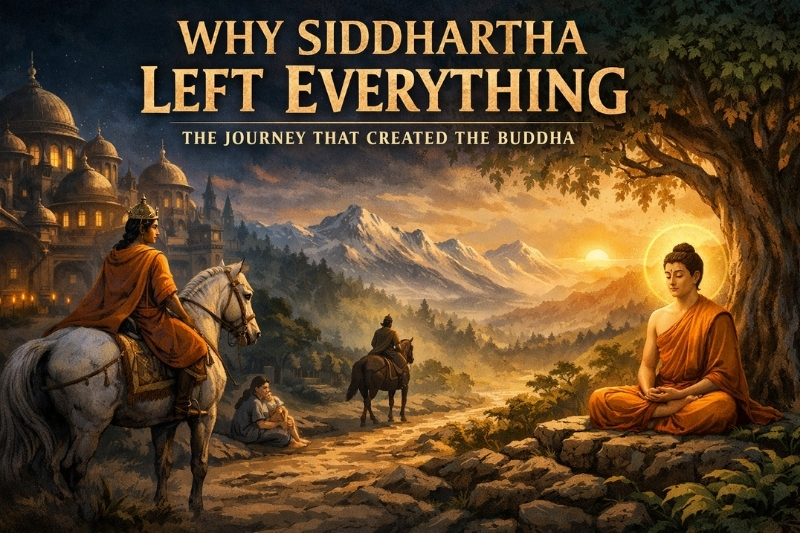
Have you ever felt like you were living someone else’s dream? You have the comforts, the technology, and the daily routine, but something deep inside feels empty.
Over 2500 years ago, there was a young boy whose name was Siddhartha Gautama, who felt exactly the same.
But there was a difference. You must be thinking, what difference? His house was a literal palace of gold, and his job was to rule a kingdom as a god king.
This deep dive story explains why the man who had everything chose to leave his life behind in search of life’s meaning. The story shows how a person used bravery & mental battle to discover the ultimate truth.
The Prophecy: A King’s Worst Nightmare
Before Siddhartha drew his first breath in the dense gardens of Lumbini (modern-day Nepal), a shadow hung over his golden cradle. His father, King Suddhodana, ruled as King over his warriors while following traditional customs. The King desired to have a son who would become his heir to carry his sword and expand his kingdom.
But the royal seers saw a different vision. They predicted a child who would either be:
- The Chakravartin: A world-defeating emperor who would unite all of India under one iron banner.
- The Gautama Buddha: A penniless monk who would bring the world to its knees with nothing but wisdom.
For the King, the MONK option was a disaster. He decided right then: “I will make this world so perfect that he will never want to leave it.”
The Gilded Cage: A Life of “High-Definition” Luxury
King Suddhodana gave a very luxurious life to his son Siddhartha for 29 years of his life. He built three massive palaces, each designed to distract the Prince from the passage of time. These were not just buildings; they were sensory distraction chambers.
- The Palace of Spring: Where the air always smelled of fresh jasmine and the temperature never dropped.
- The Palace of Summer: Where marble floors were cooled by hidden channels of mountain water.
- The Palace of Winter: Where the finest silks and warmest fires kept the chill of mortality at bay.
Siddhartha Gautama Buddha was surrounded by “the beautiful people.” His guards were young and muscular. His dancers were stunning. The moment a servant made any noise or displayed even one grey hair, they were taken away to another location during the night time.
Siddhartha didn’t know that humans could get old. He didn’t know that bodies could fail. Gautama Buddha lived in an endless golden NOW.
Siddhartha was married to a very beautiful girl named Yashodhara and eventually had a boy named Rahula. By every modern metric, he had won in life. But the human soul cannot be fed with silk alone.
The Sights: The Moment the Reality Shattered
The truth will find its way to reveal itself when you make the highest walls. The Prince came to realise that his existence had turned into a dramatic performance. He convinced his faithful charioteer Channa to accompany him into the urban area.
The King tried to repair the street conditions before the Prince’s arrival, but destiny had other plans. The secret journeys of Siddhartha Gautama Buddha led him to witness the Four Sights, which transformed historical events.
The First Sight: Old Age
Siddhartha saw a ghostly presence through a side street. The man was looking doubled over as his body showed signs of extreme weight loss. The Prince asked Channa about the identity of the creature that he had just seen.
Channa told him the truth: “That is an old man, Prince. Time has eaten his strength. This path is waiting for you, for the King and for me.”
Sight 2: The Biological Betrayal (Sickness)
Next, he observed a man who was rolling on the dirt while his body showed many sores, and he suffered from a constant cough and high fever. Siddhartha understood that the physical body does not function as a defence; it is a fragile vessel.
Siddhartha realised that the body is not a temple, it is a fragile machine that can break at any moment. No amount of palace food could protect him from germs.
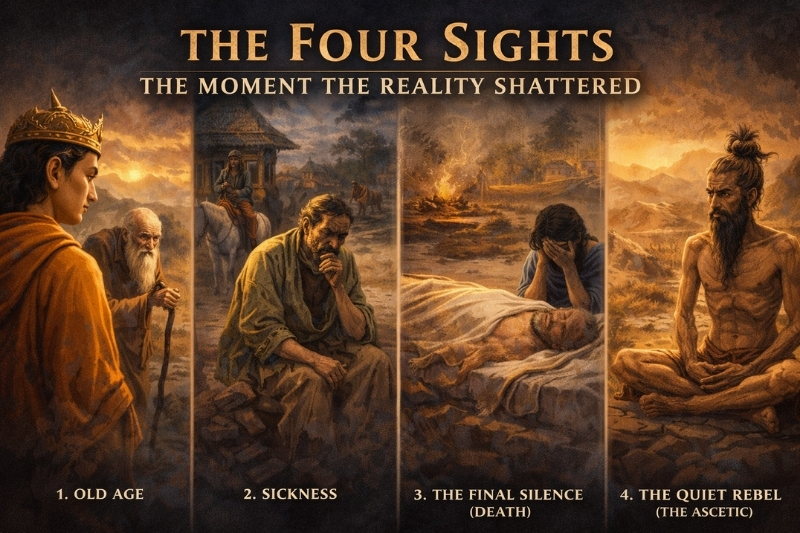
Sight 3: The Final Silence (Death)
Gautama Buddha saw the funeral procession, the body cold and still, being pulled to the ground for cremation. The family members were crying terribly before his eyes, their tears pressing down on his heart.
“Where is he going?” Siddhartha asked. “Nowhere,” Channa replied. “The flame has gone out. This is the end of every story, Prince. No one escapes the grave.”
Sight 4: The Quiet Rebel (The Ascetic)
The Prince saw a man who had nothing. He wore no footwear, had no valuable items, and only had a basic robe with him. The man’s display of deep and unbreakable calmness created a more serene appearance than the Prince’s royal homes.
At that moment, Prince realised there was a way to find peace despite the chaos of the world.
The Night of the Great Departure
The return to the palace after these sights was miserable for the Prince. The dancing girls looked like skeletons to him now. The fine food tasted like ash. The man observed his livelihood and understood they existed as temporary borrowing.
He experienced a spiritual emergency. His stay would result in him becoming a king who died without knowledge. Gautama Buddha departure would give him the chance to discover the solution that enables people to overcome death.
Why did Gautama Buddha leave his family?
The critics ask: “How could he leave his wife and his newborn son, Rahula?”
The Buddhist tradition views this as the Ultimate Sacrifice. His departure happened because he loved humanity more than his wife and son. He believed that discovering the solution to suffering would prevent his son from dying without a mentor.
At midnight, he took one last look at his sleeping family. He wanted to wake them, but he thought his heart would stop working.
He rode to the boundary of the kingdom after he climbed onto his horse Kanthaka with Channa as his companion. He used his sword to cut his royal hair, and he gave his jewels to others before he entered the forest by himself.
The War on the Self: His Ultimate Learning
Siddhartha was not made a Zen Master overnight. Instead, he went through a spiritual boot camp with the intention of nearly destroying him.
He merged with five ascetic monks of extreme views who believed that self-torture was the only way to free the mind. Furthermore, being as he was a man of extremes, Siddhartha took his ascetic practices farther than anyone else:
- The Fasting: He ate so little that when he touched his stomach, he could feel his spine.
- The Breath: Gautama Buddha practised holding his breath until his head felt like it would explode.
- The Bed: He slept on thorns and in the middle of rotting corpses to conquer his fear of death.
- The Failure: He collapsed while attempting to cross the river. The current nearly swept him away because his body weight was too low. He discovered a dark truth about hunger, which states that starving yourself only leads to your stomach wanting food.
Gautama Buddha accepted a bowl of rice from a village girl named Sujata. His monk friends called him a sellout and left him. Siddhartha experienced complete isolation from others. He had no family, no kingdom, and no friends.
The Six Years of Extreme Struggle
Siddhartha achieved his status as Gautama Buddha through his years of dedication. The Forest Dweller period lasted for six years, during which he tested his mental and physical boundaries.
Learning from the Masters
His initial studies included learning from the best meditation teachers who lived during his time, Alara Kalama and Uddaka Ramaputta. He mastered the ability to reach deep trances and experience “nothingness.”
The world continued to suffer when he opened his eyes. Meditation was a “break” that did not solve his problems.
The Path of Starvation
Gautama Buddha then joined five ascetics who believed that the body traps the soul. The body needs to be “crushed” to achieve soul freedom. Siddhartha became the most extreme of them all:
- He slept on beds of thorns.
- He lived in graveyards among rotting corpses.
- He ate so little, eventually just one grain of rice a day, that his skin turned black and his ribs stuck out like a bird’s cage.
- He fainted from weakness while attempting to bathe in the river.
Gautama Buddha realised: A withered body cannot support a clear mind. A village girl named Sujata saw him and offered him a bowl of milk rice. He ate it, and his strength returned. This led to his discovery of The Middle Way, the path between being a spoiled prince and a starving hermit.
The Battle of the Mind: Sitting Under the Bodhi Tree
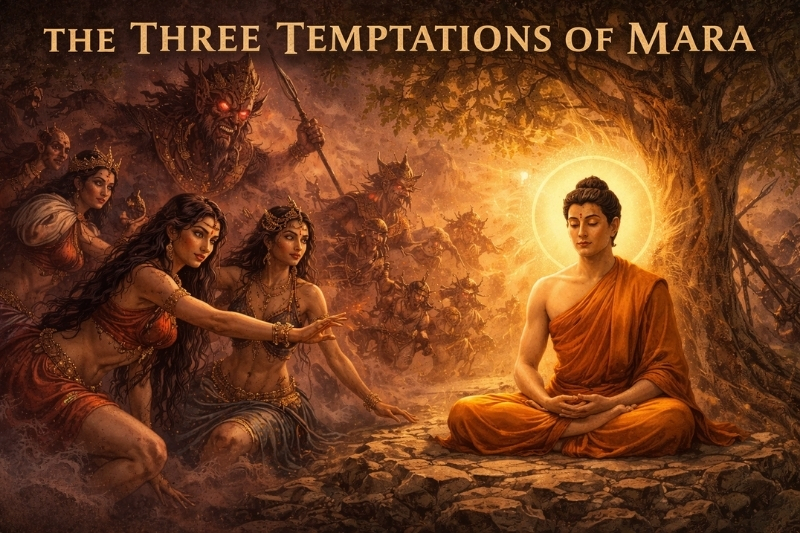
Siddhartha travelled to the location which is currently called Bodh Gaya, and he seated himself beneath a big Pipal tree. He made a famous vow: Let my skin, sinews, and bones weaken, but I will not move from this spot until I find the truth.
The story reaches its most exciting point at this moment. The demon Mara, who symbolises the human Ego and our most profound fears, attacked him while he was meditating.
The Three Temptations of Mara:
- Lust: Mara sent his beautiful daughters to distract Siddhartha with desire. Siddhartha remained as still as a mountain.
- Terror: Mara sent an army of demons, flaming arrows, and screaming monsters. Siddhartha Gautama Buddha looked at them with compassion, and the arrows turned into lotus flowers as they fell around him.
- The Ego: Mara challenged his right to be enlightened. Who are you to find the truth? Mara sneered. Who will witness your goodness?
Siddhartha Gautama Buddha used his body to touch the earth after he refused to argue with others. The earth itself thundered: I am your witness. Mara vanished like a bad dream.
The Enlightenment: What Did He See?
As the morning star rose, Siddhartha’s mind opened. He saw:
- The Interconnection of All Things:Nothing exists in emptiness. A flower needs the sun, the soil, and the rain. We are all knitted together.
- The Cause of Suffering:We suffer because we try to hold on to things that are naturally changing.
- The Solution:If we stop the attachment and the craving, we find Nirvana, the state of perfect & unshakeable peace.
He was no longer Siddhartha. He was the Gautama Buddha.
The Return to Kapilavastu: Healing the Past
The gautama buddha returned to his home city after several years of absence. The King is waiting for a royal parade when his son enters with a shaved head and a wooden bowl to request food leftovers.
The King was humiliated. Why are you shaming our bloodline?
The Gautama Buddha looked at his father with eyes that had seen the beginning and end of the universe. He didn’t argue with people; he taught them.
His father learned from him that the true kingdom exists in human beings, not in physical structures.
Gautama Buddha’s wife, Yashodhara, who had suffered heartbreak for many years, finally became part of his movement. His son Rahula became his student. Siddhartha saved his family from their golden cage when he escaped his own and left them behind.
The Eightfold Path: A Manual for Modern Life
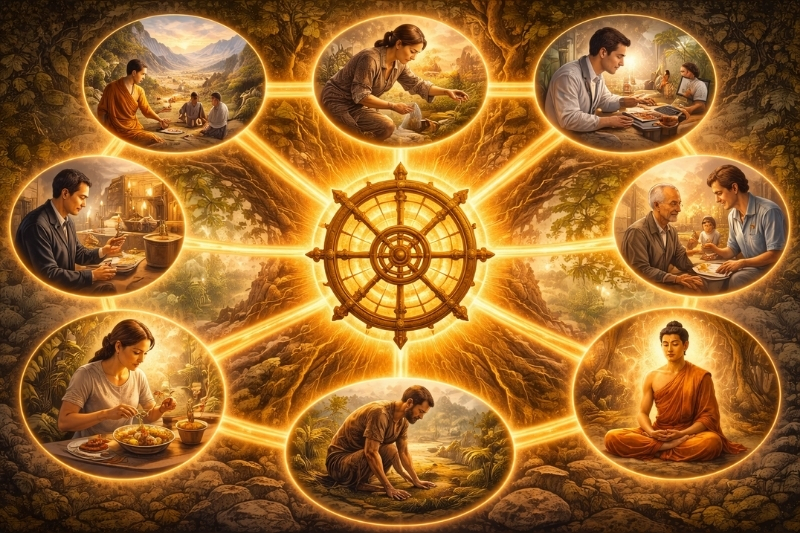
The Gautama Buddha did not want people to just believe him. He gave them a practical 8-step plan to fix their lives. This is highly relevant for anyone dealing with stress today:
- Right View: Understand that your actions have value.
- Right Intention: Commit to being kind and harmless.
- Right Speech: No lying, gossiping, or internet trolling.
- Right Action: Protect life, be honest, and be faithful.
- Right Livelihood: Do work that helps the world rather than hurting it.
- Right Effort: Train your mind to drop negative thoughts and keep positive ones.
- Right Mindfulness: Be fully present. When you eat, eat. When you walk, walk.
- Right Concentration: Use meditation to keep the monkey mind still.
The Final Days: “Be a Lamp Unto Yourselves”
The Gautama Buddha spent 45 years walking across India, teaching anyone who would listen, from kings to street sweepers. At the age of 80, he understood that his death was approaching.
His final words are a message for all of us: “All conditioned things are subject to decay. Strive for your own freedom with diligence.”
He wanted people to stop worshipping him as a god. He wanted people to stop creating statues and building golden temples. He wanted people to discover their own paths through life.
Gautama Buddha famously told his disciples Be a lamp unto yourselves.
This means: do not just follow a leader blindly, test the truth in your own heart.
Conclusion: Finding Your Own Middle Way
The Buddha appeared from Siddhartha Gautama’s transformation from Prince to Gautama Buddha. He founded a religion through his discoveries about the existing psychological truths.
He showed that human beings can achieve inner peace without needing divine status through their ability to confront reality with complete honesty.
Siddhartha left all his controls to create a Map that leads to the peace he discovered.
The question is: Now that you know the story, will you take the first step on the path?