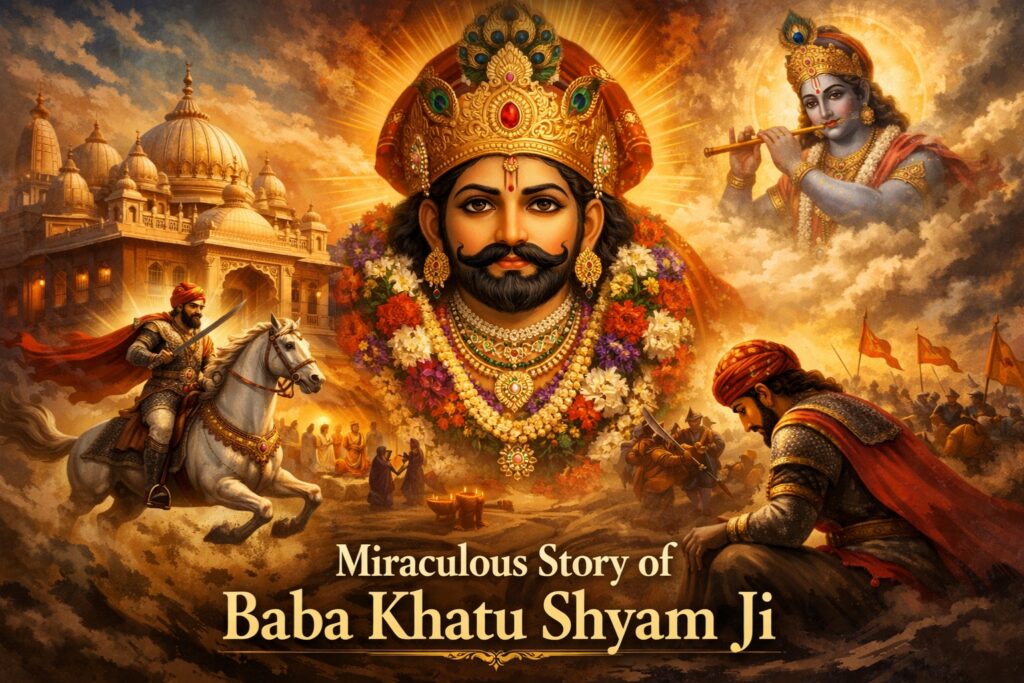
The Miraculous Story of Baba Khatu Shyam Ji: The Legend of Faith, Sacrifice, and Blessings
Khatu Shyam temple is situated in Rajasthan. The air in the dusty town of Baba Khatu Shyam ji does not feel normal it is something divine. Every few seconds the silence of the desert is shattered by a thunderous roar: “Haare Ka Sahara Baba Shyam Hamara” which means The Support of the Defeated is our Baba Shyam.
In a world obsessed with winners, why is millions of people’s favorite God the one who LOST everything? Why is a severed head worshipped as the King of the Kaliyug? This is the 5000 year old magical thriller of Barbarika the warrior who was too powerful for his own good.
The Divine Lineage: Child with the DNA of Giants
To understand the divine power of Khatu Baba we have to understand his roots. His family is related to the Mahabharat.
Barbarika descended from his grandfather Bhima who was the Pandava brother who had the greatest strength. His father Ghatotkacha fought as a warrior who had both demon and human heritage and he brought destruction to the Kurukshetra battleground. His mother Maurvi descended from the royal family of the Naga King who ruled over serpents.
Barbarika was not an ordinary child. When he was growing up he adapted strength from his grandfather and intelligence & magical abilities from his father. From a young age he was a devoted follower of Lord Shiva and Goddess Durga.
The Training of a Legend
The boy Barbarika spent years in deep meditation. It is said that he was a true devotee of the Lord he performed penance so intense that the gods themselves were forced to come to the earth. God was impressed by the act of that boy Barbarika as he was disciplined and pure at heart. Lord Shiva granted him three infallible arrows and a bow that would make him the most powerful archer in the three worlds.
The Secret Power of the Three Arrows (Teen Baan)
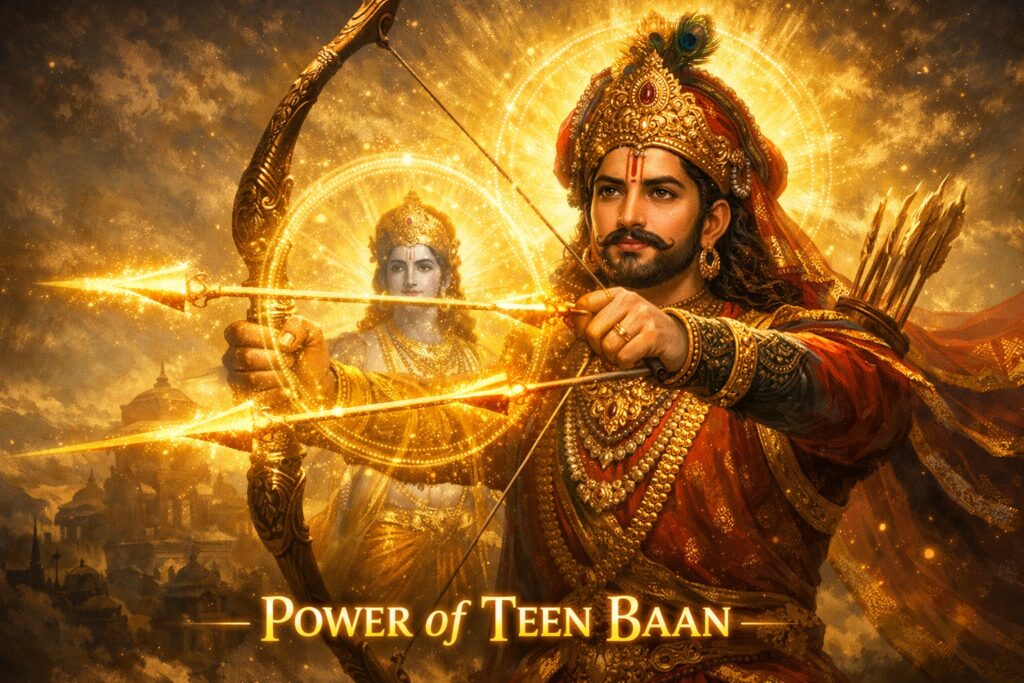
The genuine power of Baba Khatu Shyam Ji (Barbarika) in the Mahabharata extended beyond his courage as he possessed three divine arrows that functioned as his ultimate weapon.
The arrows worked as more than mere combat tools because they possessed the power to define a battle’s result in an instant.
The first arrow enabled him to select all targets he wanted to destroy while the second arrow protected all elements that needed protection and the third arrow executed the task with perfect precision.
The combination of these abilities made Barbarika almost unbeatable because no military force, battle plan or defensive system could resist his powers.
The hidden truth about the arrows shows that they executed the commander
The mind of the user needed to maintain both clarity and purity for the powers to use because Lord Krishna himself recognized the powers as both divine and unsafe.
The deeper meaning behind Teen Baan:
- They describe the rare ability to clearly identify what truly deserves to be removed from life & what must be protected at all costs
- They reflect the importance of having complete control over one’s thoughts before taking any emphatic or irreversible action.
- They symbolize that real strength lies not in destruction but in using power with awareness, balance and responsibility.
A Mother’s Vow: The Turning Point of the Legend
The world was divided into two factions when the drums of the Kurukshetra war started to sound. The battle required every king, warrior and mercenary to select their faction between the righteous Pandavas & the deceitful Kauravas.
Barbarika, who possessed great power, approached his mother Maurvi to request her blessings for his war participation. His mother, who possessed wisdom, understood that her son had the ability to alter universal peace so she posed him an impossible challenge through a complex question.
“My son, if you go to this war, which side will you support?”
Barbarika showed his usual behavior when he answered the question because he had no personal hatred toward anyone. He declared his intention to fight for the losing team which he described with the words “Haare Ka Sahara” because he wanted to defend his motherland.
The man believed this was the fairest action one could perform and supported the weaker side to prevent any martial force from overpowering his opponents. The vow he made would result in a divine paradox which only Lord Krishna could resolve according to his belief.
The Meeting at the Peepal Tree: Lord Krishna’s Strategy
The divine strategist Lord Krishna identified Barbarika as a “wild card” because he understood Barbarika’s abilities.
Barbarika’s participation in the battle would guarantee victory for his chosen faction. Barbarika would join the Kauravas after they suffered defeat and would proceed to eliminate the Pandavas.
The Pandavas faced imminent defeat when Barbarika’s vow forced him to abandon his current union and proceed to kill the Kauravas.
The battle would continue to unfold as an endless cycle of destruction which would ultimately lead to the end of all life on Earth.
To save humanity, Krishna disguised himself as a humble Brahmin and met Barbarika on his way to the battlefield.
The Test of the Leaves
Krishna disputed Barbarika’s claim that he was the top archer.
“You say you can win the war with three arrows? Prove it. Can you pierce every leaf of this Peepal tree with just one arrow?”
Barbarika smiled before he shut his eyes to meditate on his arrow. Krishna secretly took one leaf from the tree during Barbarika’s meditation and he covered it beneath his foot.
Barbarika released the arrow. The arrow flew through the air and struck every leaf on the tree. The arrow did not return to the quiver which surprised Krishna. The arrow started to buzz around Krishna’s foot instead of returning to him.
“O Brahmin Dev,” Barbarika said humbly, “Please move your foot. There is a leaf beneath it. If you do not remove your foot the arrow will pierce it to fulfill the task. Now Krishna was convinced. This young man was truly unstoppable.
The Sheesh Ke Daan: The Greatest Sacrifice in History
Krishna showed his real identity to Barbarika. He described the conflict between the vow and its results which would cause complete destruction of the world.
He told Barbarika that for war to start on a holy note, the head of the “greatest Kshatriya” must be sacrificed.
Krishna stated that only three Kshatriyas exist in the world as great warriors. “Myself, your grandfather Bhima, and you. Since I am a guide and Bhima must fight you are the one who must make this sacrifice.”
Barbarika showed his agreement without any delay. His dedication to Krishna was so strong that he chose to die for others. He made a very heartwarming request to the lord-
“I have come all this way to see the Great War. I wish to witness the battle of Kurukshetra with my own eyes.”
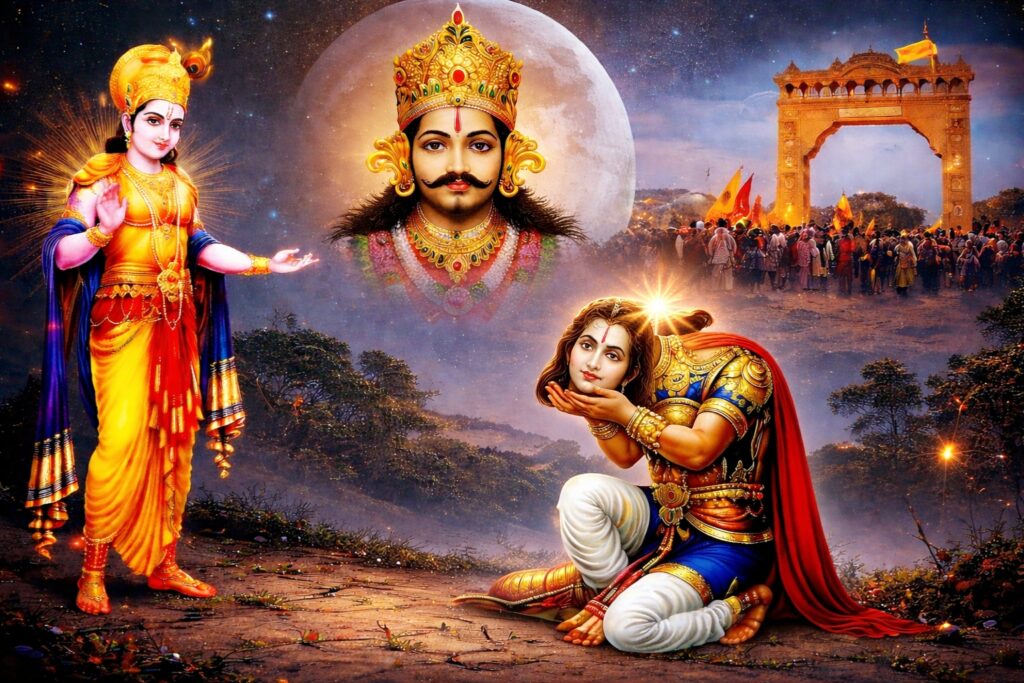
Krishna granted his wish. On the 12th day of the Shukla Paksha of the month of Phalgun, Barbarika performed his morning prayers, took his sword and severed his own head.
Krishna took the head and placed it atop a high hill which overlooked the battleground of Kurukshetra. Even though his body was gone, Barbarika’s head maintained existence as “alive” through Krishna’s blessing, which allowed him to observe all events during the 18 day war.
The Verdict of the War: Who Truly Won?
The Pandavas achieved victory after 18 days of fighting because their opponents died in battle. Their victory brought them pride. Bhima said his mace brought him victory while Arjuna said his Gandiva bow won the battle for him.
To settle the debate, they went to Barbarika’s head which served as the silent witness to everything from above.
The head laughed a divine laugh and said:
“O Pandavas, you are mistaken. I saw no warriors. I saw no arrows. All I saw was the Sudarshana Chakra of Lord Krishna whirling across the battleground cutting down the ego of the evil. And I saw the Goddess Mahakali drinking the blood of those who stood against Dharma. It was Krishna and Krishna alone who won this war.”
The Pandavas bent their heads in shame and realization.
Why the World Worships Him as “Shyam”
Lord Krishna was so pleased with Barbarika’s humbleness and the ultimate sacrifice that he bestowed upon him a boon that would last forever.
Krishna declared
“Barbarika you have given up everything while asking for no rewards in exchange. You will be worshipped through my name during the Kaliyug which is the present age of darkness. People will call you Shyam. You will become the deity worshipped by those who suffer from heartbreak and by those who feel defeated. Anyone who brings their troubles to you and speaks your name with a pure heart will be granted their wishes.”
Baba Khatu Shyam Ji is the reason for his name. In Hindu tradition “Shyam” stands as one of the most favorite names of Krishna which describes his beautiful dark complexioned appearance.
Hidden Facts About Khatu Shyam Ji (The Secret of the Temple)
The story doesn’t close in Dwapara Yuga, it strides into modern times, flaunting uncanny facts.
1. The Discovery of the Head
The head of Barbarika stayed hidden for hundreds of years. According to beliefs, the head became buried in Khatu village (Rajasthan) at the beginning of the Kaliyug.
The cow displayed the hidden object when she began standing at a specific location while her udder released milk. The villagers discovered the divine head after they mined the area.
2. The Unfinished Idol
Visitors to the Baba Khatu Shyam Ji temple will discover a special feature. The temple has an idol which displays only the head of the deity instead of a complete body statue which most Hindu temples use.
The Sheesh Ke Daani statue is a constant reminder of his sacrifice while showcasing an elegant design featuring gold, flowers & jewelry.
3. The Changing Expressions of the Face
Regular devotees and priests claim to observe changes in the idol’s facial expressions at different times of day.
The morning shows him as a young child whereas the afternoon presents him as a powerful warrior and the evening reveals him as a peaceful elderly sage.
4. The Water of Shyam Kund
The pond near the temple which people call Shyam Kund serves as the location where the head was first discovered. The temple’s faithful devotees believe that the water has special healing powers that can cure any sickness.
Phalgun Mela which people attend to take a dip in the water gives them the ability to cleanse themselves of all their past misdeeds.
The Philosophy of “Haare Ka Sahara”
The modern world knows the phrase “Haare Ka Sahara, Baba Shyam Hamara” as an anthem that many people across the world sing today. But what does it really mean?
The world today values success and victory together with “hustle culture” but Baba Khatu Shyam Ji stands as the only God who directly associates himself with those who experience defeat.
- If you have lost your business, he is your support.
- If you have lost a loved one, he is your comfort.
- If you have lost your health, he is your healer.
His mother’s wish that he must support the losing side became a cosmic law. Through his connection to those who have been defeated he provides people with a way to help him during their most difficult times.
The Grand Celebration: The Phalgun Mela and Nishan Yatra
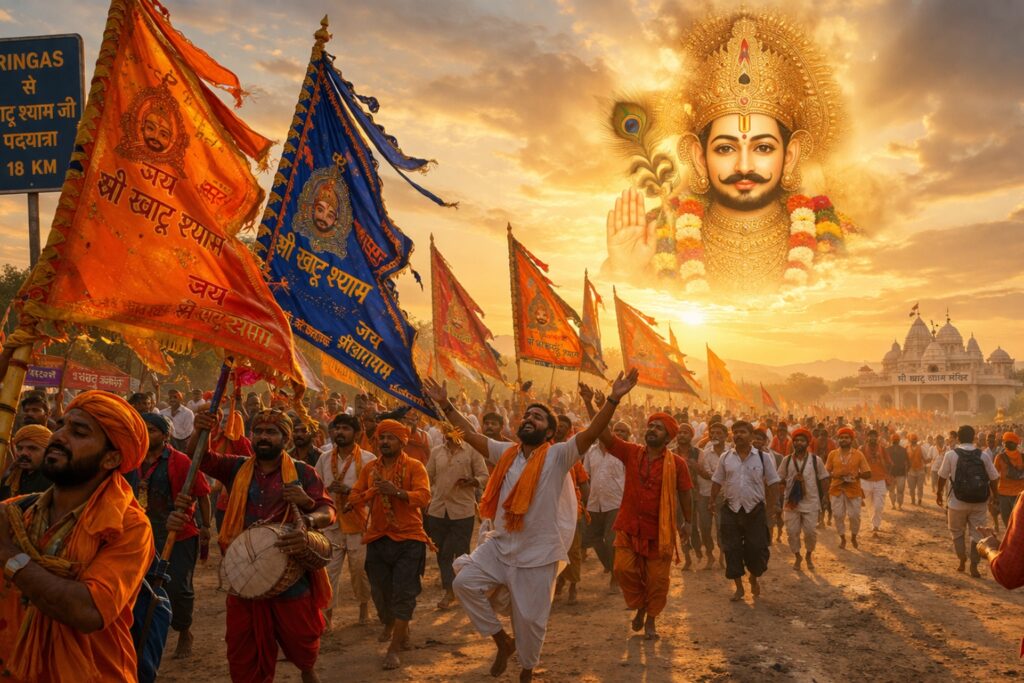
The most vibrant time to experience the legend of Baba Khatu Shyam ji is during the Phalgun Mela which takes place every year between February and March. The whole city of Khatu transforms into a festival of religious devotion.
The Significance of the Nishan
The Nishan Yatra is the main element that defines this festival. A Nishan functions as a sacred flag that displays saffron, blue and multicolored designs to symbolize the head of Barbarika.
Thousands of devotees start their journey from the town of Ringas, walking 18 kilometres to the Baba Khatu Shyam Ji temple while carrying these heavy flags. Their “Bhakti” drives them to dance & sing bhajans while they ignore their foot blisters. The act of bringing the Nishan to the temple serves as a declaration that I give up my ego and my head to you just as you did for Krishna.
How to Plan Your Visit to Khatu Shyam Ji
If you want to visit Baba Khatu Shyam ji, here is a practical guide for your pilgrimage:
Best Time to Visit
- Phalgun Mela (Feb/March):This is the peak time. It is crowded but the energy is divine.
- Winter (October to March):The weather in Rajasthan is pleasant, making it ideal for the 18km walk from Ringas.
Travel Logistics
- By Train:Reach Ringas Junction. From there you can find thousands of shared jeeps and taxis.
- By Air:Fly into Jaipur. Baba Khatu Shyam ji is about a 2-hour drive from the airport.
- By Road:High quality highways connect Khatu to Delhi, Agra and Ahmedabad.
Temple Timings
The temple usually opens at 5:30 AM for the Mangala Aarti and stays open until late at night with brief closing periods for Bhog. During festivals the temple often stays open 24 hours a day to accommodate the millions of pilgrims.
Conclusion: Why the Legend Matters Today
The Divine story of Baba Khatu Shyam ji is more than just ancient history. It is a lesson in Ego vs. Surrender.
Barbarika had enough strength to control the entire world. His collection of arrows provided him with the ability to defeat any enemy. However, he decided to abandon everything because he believed in Lord Krishna’s divine plan.
The Sheesh Ke Daani story shows that people who compete to become “the greatest” should recognize that true strength comes from sacrifice and the ultimate triumph comes from faith.
The moment you enter Baba Khatu Shyam ji through its gates and yell “Jai Shree Shyam” you create a connection with a warrior who achieved Godhood through his ability to give.
Baba Khatu Shyam ji keeps his doors open to all who have been defeated by the world whether they seek a miracle or need to find peace. The title Haare Ka Sahara describes him accurately.