Most people think it was a normal wedding. It wasn’t. It was a 3000-year battle of willpower between a princess and a God.
The story of the Shiv Parvati Vivah is not just a normal wedding; it is the ultimate cosmic drama of patience, love, and the power of persistent determination.
This story describes how a princess became an ascetic to win the love of the God who left his kingdom.
In this deep dive, we explore Mata Parvati’s mystical path of Tapasya, the hurdles she faced, and the divine Shiv Parvati Vivah that restored balance to the universe.
The Great Cosmic Void: Why Mahadev Turned His Back on the World
Before knowing the whole story, we need to understand Lord Shiva’s condition to grasp the Shiv Parvati Vivah history. Shiva experienced such deep sorrow after his first wife Sati died that it almost brought about a cosmic freeze. He entered into an everlasting state of deep meditation, which people call Samadhi.
He went to Mount Kailash’s frozen & unreachable mountain summits to escape all worldly matters. He transformed from an active participant into a quiet watcher of the events. The world began to lose its natural flow when Shiva (Purusha/Consciousness) and Shakti (Prakriti/Nature) failed to unite.
The Rise of Tarakasura
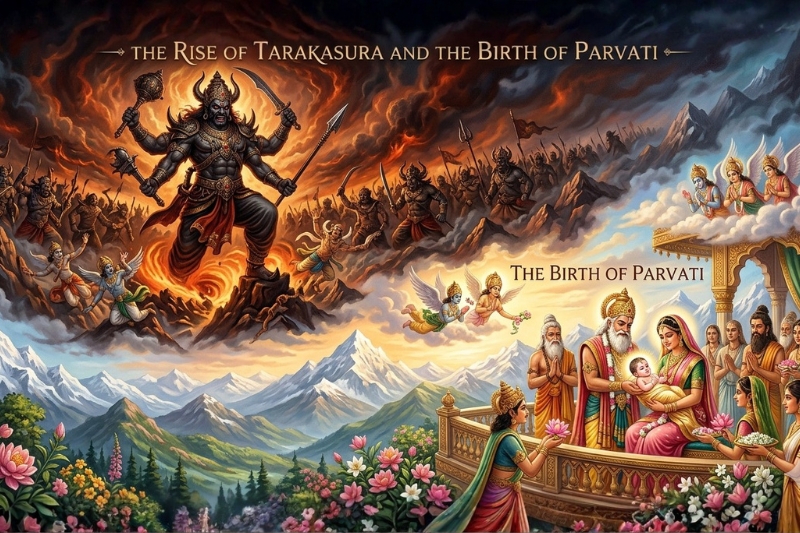
The demon Tarakasura used the state of chaos in the world to his advantage. He received a special power from Lord Brahma that could be used against him only by a son of Shiva.
Showed arrogance because he understood that Shiva lived as a celibate monk who had renounced all worldly things. He believed he could not be defeated because a “son of Shiva” could never exist in reality.
The Devas (Gods) were in a panic. The world needed both a hero and a Shiv Parvati Vivah ceremony to fulfil its requirements.
The Birth of Parvati: A Divine Mission in the Himalayas
The King of Mountains, Himavan, and his wife, Maina, welcomed a daughter through their royal residence in the Himalayas. A couple named their daughter Parvati because she was born on the mountain.
Parvati had a different behaviour from other royal children during her early years. She spent her time quieting herself to create Shivalingas from river sand while other children played with toys.
She carried the Samskaras (soul memories) of her past life as Sati. Her soul recognised one ultimate reality, which stated that she was connected to Mahadev. The inner calling started the process that ended with Parvati Tapasya becoming a renowned event for Lord Shiva. She lived as more than a princess.
The Struggle of King Himavan
Her father, Himavan, saw her sitting in the snow and experienced two conflicting emotions of pride and terror. His daughter preferred to study the “King of Ghosts” instead of his position as King of the Mountains.
The royal obligation and holy fate of her family created a permanent conflict that lasted throughout her childhood years.
Why Did Narada Muni Prophesy a Hard Life for Parvati?
The divine sage Narada Muni visited King Himavan during the afternoon of one day. Parvati’s palm, on which he looked, revealed to him a future that brought both terror and wonder to her parents.
“This girl is destined to marry the Lord of Lords,” Narada prophesied. “But her husband will be a homeless yogi, a man with matted hair and skin smeared with funeral ash. He will have no family, no home, and no wealth. He lives where others die in the cremation grounds.”
Queen Maina was heartbroken. She had dreamt of a prince in a golden chariot. “How can my delicate lotus flower live with a madman?” she wept.
But Parvati’s eyes sparkled. She knew Narada wasn’t describing a beggar; he was describing the Vairagi, the only man who truly understood the nature of existence.
The Burning of Kamadeva: Why Physical Beauty Was Turned to Ash
Devas were in a hurry. Tarakasura was destroying the heavens, and they needed Shiva to wake up. They sent Kamadeva to Kailash in order to establish attraction between Shiva and Parvati to achieve the goal of Shiv Parvati Vivah .
Parvati approached Shiva to present him with flowers. Kamadeva shot his Pushpa Bana (arrow of desire) at her.
Shiva opened his eyes to see Kamadeva, but instead of falling in love with Kamadeva, he experienced an intense, violent reaction because someone had interrupted his meditative practice. His Third Eye opened, and a portal of cosmic destruction and a flash of white-hot fire turned Kamadeva to ashes in seconds.
Shiva left without saying anything to anyone. He disappeared into the mountains after ignoring Parvati’s attractive appearance. This event marked the moment of change.
Parvati discovered that Mahadev cannot be defeated through external deceptive methods. The only method for him to achieve victory is through his connection with the universe. She considered beauty to be a worldly tool, but she required spiritual instruments for her purpose.
The Radical Choice: Trading Palace Silks for Tree Bark
Most people would have given up after being rejected by a God who just killed the God of Love. Parvati, who belonged to the mountain, realised her victory over the “Greatest Ascetic” required her to acquire the status of the most accomplished Yogi.
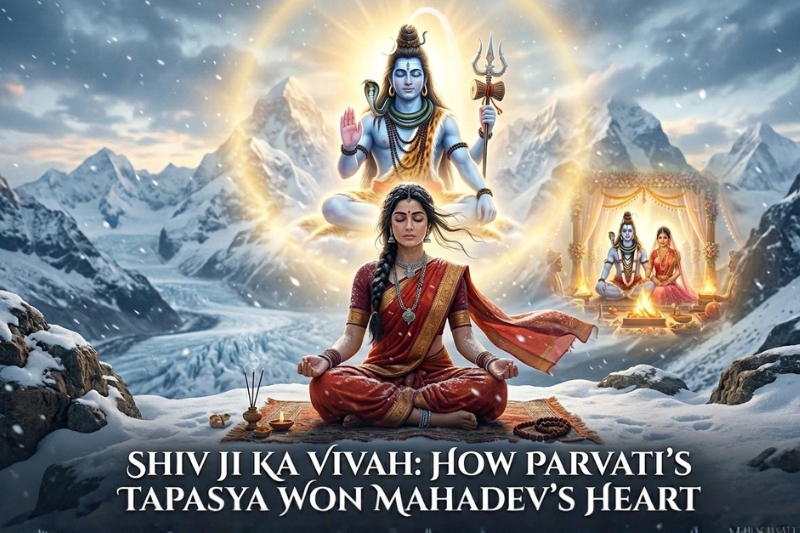
She took off her silk sarees, and she broke her diamond necklaces before she entered the most distant and frigid areas of the forest. This marked the beginning of the legendary Parvati Tapasya. She spent thousands of years living outdoors to show that her love existed as a permanent state of presence rather than as an emotion.
The Mother’s Lament
Queen Maina attempted to prevent her from leaving. “U-Ma!” she cried (meaning ‘O child, do not go!’). From this, Parvati earned her other name, Uma. But the call of the wild and the call of Mahadev were stronger than the comfort of the palace.
How Parvati’s 3,000-Year Penance and Extreme Tapasya Won Mahadev’s Heart
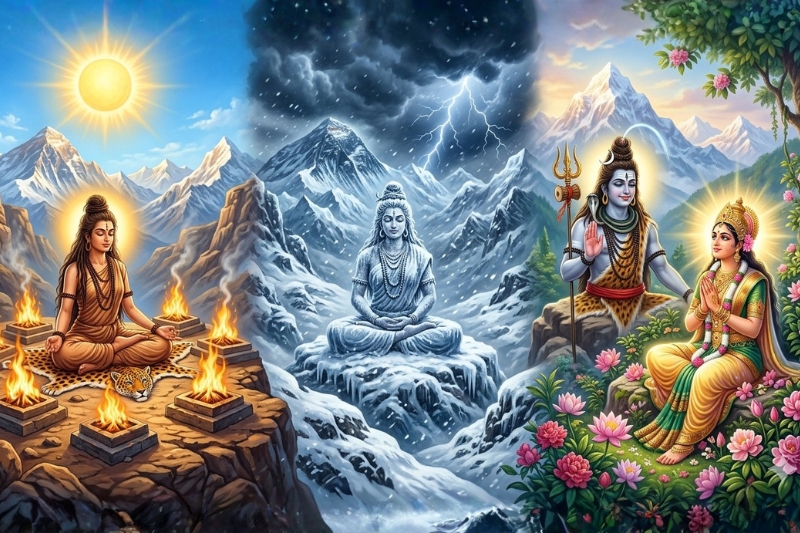
It was important for Parvati to generate internal heat (tapa) powerful enough to resonate through the universe to concretely realise her goal of Shiv Parvati Vivah.
Phase 1: The Summer of Five Fires (Pancha-Agni)
During the hot summer season in the Himalayas, she sat in a circle of four massive bonfires while the sun burned down on her. She became the “fifth fire.” Her mind stayed focused on the mantra: Om Namah Shivaya. She kept her eyes open as smoke entered her lungs and the heat burned her skin. She used the flames to destroy her royal ego.
Phase 2: The Ice Vigil and the Monsoon
The monsoon arrived, and she stayed standing in the rain. She maintained her balance on one leg while the winter ice froze the waterfalls, and she stood in the river’s freezing water. Her body turned blue, her arms and legs became stiff, but her resolution remained strong. The local sages began to gather just to watch her; she had become a living monument of focus.
Phase 3: The Vow of “Aparna”
She reached a point where she refused to eat prepared meals. She started to consume only fruits. She continued to drink only water. She reached a point where she would not consume even the dry leaves that had fallen from the trees. This is why she is called Aparna (the one without leaves).
She existed between two states of being, which included air and her simple determination. Her body had reached an extreme state of weight loss, yet people could observe her inner light from cosmic heights.
Shiva’s Final Test: The Mystery of the Disguised Brahmin
Parvati’s penance reached such high levels of energy that it started to shake the entire Mount Kailash mountain range. Shiva made his final decision to compete in one last action. He transformed into an arrogant Brahmin boy who looked like a young man to visit Parvati at her cave.
“Why are you wasting your youth, lady?” the Brahmin mocked. “Shiva? The man who lives in graveyards? He has no money. He’s a freak! He doesn’t even have a house to keep you in. You are a princess, go find a King who can give you a palace, not a cave where ghosts roam.”
Her eyes had a fierce gleam, and she did not see an old man before her but rather someone snubbing what she believed in. She replied:
“You see his exterior because you are blind to the interior. He is the master of all that is seen and unseen. He wears snakes because he is the lord of time. He wears ashes because everything in this world eventually turns to ash. If you speak one more word against my Mahadev, I will burn you with my silence!”
Shiva showed his genuine nature when he became satisfied with his current state. Mahadev appeared in his complete form while he rested on his Trident. “I am your slave,” he whispered. “You have bought me with your devotion.”
The Proposal: Why Shiva Sent the Saptarishis
Shiva agreed to the request, but he was bound by his divine duties. He sent the Saptarishis (the seven great sages) to King Himavan’s palace to formally ask for Shiv Parvati Vivah.
Queen Maina remained afraid while King Himavan experienced extreme happiness. The Saptarishis had to explain the cosmic importance of this union. “This is not just a Shiv Parvati Vivah,” they said. “It is the merging of Shakti & Purusha. The world will remain in darkness until this unification occurs. Tarakasura will win, and the gods will die.” The auspicious night of Maha Shivratri was selected as the wedding date for the couple.
The Most Chaotic Wedding Procession in History: Shiv Ji Ki Barat
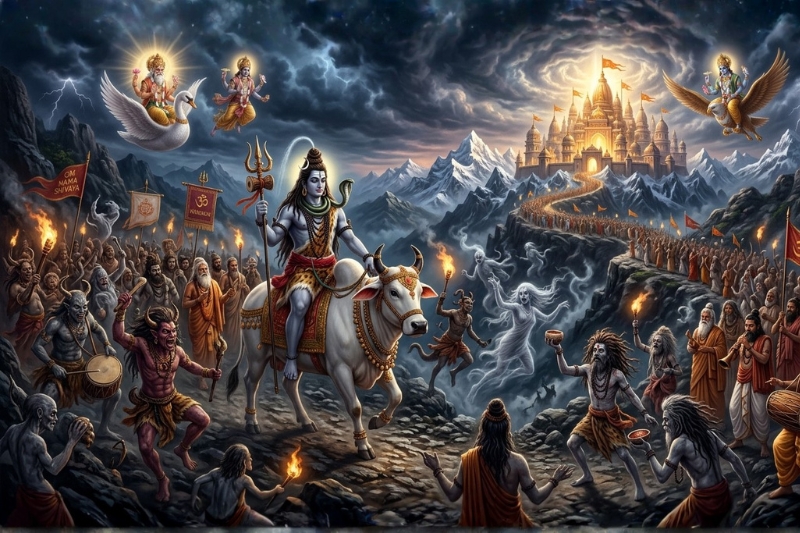
The day of the Shiv Parvati Vivah arrived. The city of the Himalayas was decorated with flowers made of light and gold. The citizens ran in fear when the Barat appeared. Shiva arrived riding Nandi the Bull instead of horses. Behind him appeared a terrifying procession of demons.
The Ganas: Wild, misshapen attendants of Shiva, dancing with raw energy.
The Ghosts and Pretas: Spirits who had no other home, celebrating their master’s joy.
The Sages and Aghoris: Men covered in ash, chanting Vedic hymns that sounded like the roaring of the ocean.
The High Gods: Brahma on his swan and Vishnu on Garuda, looking slightly out of place in this wild crowd.
The Queen Maina lost her ceremonial plate after she saw her future son-in-law, who wore a tiger skin, while snakes hissed around his neck. She shouted her refusal to allow her daughter to marry a ghost after she recovered consciousness.
The Transformation into Chandrashekhara: The Royal Union
To soothe his mother-in-law and respect the joy of the occasion, Parvati whispered a request to Shiva. The ash transformed into fragrant sandalwood paste the next moment. Snakes became necklaces of emeralds and rubies. His matted hair transformed into a crown made of starlight.
He became Chandrashekhara, the most beautiful being in the three worlds. The “Scary Yogi” became the “Divine Groom.” The cemetery ghosts transformed into attractive servants while the graveyard smells changed into the fragrance of a thousand lotus flowers.
The Queen remained silent because she had no words to express herself. The Shiv Parvati Vivah ceremony began with the recitation of four Vedic scriptures, which celebrated the Shiv Parvati Vivah between Nature (Shakti) and Consciousness (Shiva).
The Seven Sacred Vows of the Shiv-Parvati Vivah
As the couple walked around the sacred fire, the gods showered flowers. Each step was a promise to the universe:
Step 1: For the supervision of the world and the growth of all living beings.
Step 2: For the mental and physical strength to face the challenges of existence.
Step 3: For the prosperity of the earth and the welfare of all devotees.
Step 4: For the purpose of divine knowledge and spiritual wisdom.
Step 5: For the protection and nurturing of children and the future of the world.
Step 6: For the harmony of the seasons and the balance of nature.
Step 7: For eternal, spiritual friendship and the merging of two souls into one.
This wasn’t just a contract; it was a cosmic alignment. The instant their hands touched each other, all serenity in existence returned to its natural state. The rivers increased their flow strength while the flowers started to blossom during the winter season.
Why This Story Matters in Today’s Time: Modern Lessons from the Mountain
Why do we still tell the story of Shiv Parvati Vivah?
Persistence: Parvati proves that nothing is impossible if your intention is pure.
Equality: The concept of Ardhanarishvara shows that the masculine and feminine are two halves of the same whole.
Beyond Appearances: Shiva’s “scary” barat reminds us that the divine resides in everyone, the beautiful, the ugly, and the outcast.
The Birth of Kartikeya and Ganesha: The Salvation of the World
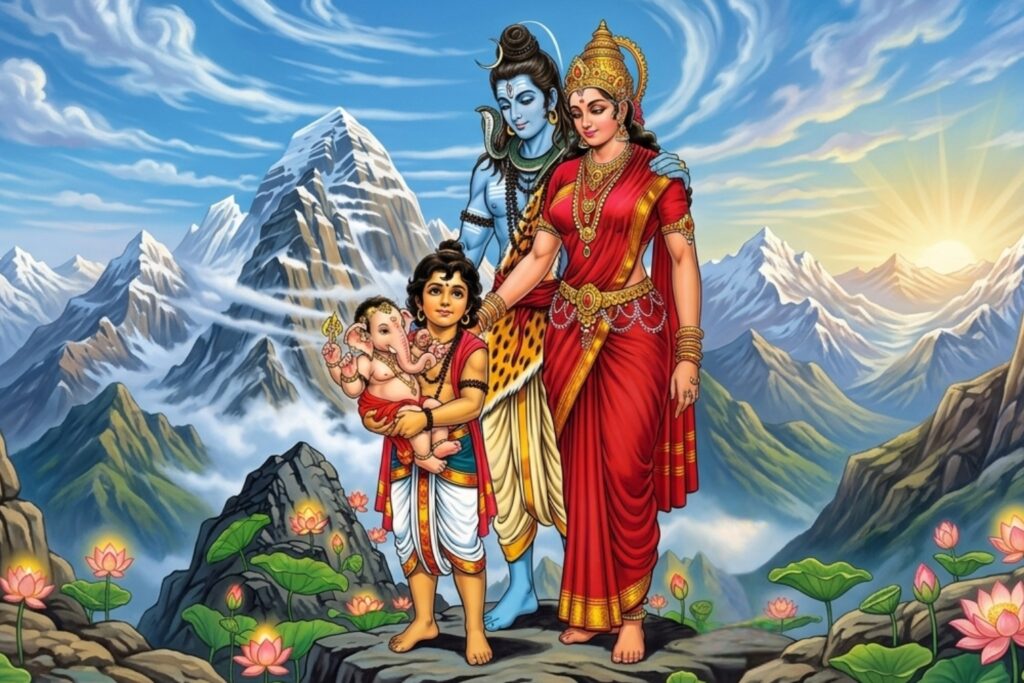
Shiva and Parvati united, which resulted in Kartikeya’s birth as the six-headed warrior god who supervised heavenly armies to defeat Tarakasura. The God of wisdom and the remover of obstacles was born later as Ganesha.
The Shiv Parvati Vivah was the biggest example of “Seva” (service) to the universe. Shiv Shakti union acts as the divine power that drives life forward because it prevents life from being stopped by demonic powers.
Even today, millions celebrate Maha Shivratri to honour this divine union. Parvati’s transformation from princess to devotee shows that love supported by Tapas has the power to change even what appears unchangeable to the Great Mahadev himself.
The Secret Symbolism of the Rituals
Every part of the Shiv Parvati Vivah has a deeper meaning.
The Ash (Bhasma): Represents the reality that everything is temporary.
The Snakes: Define the control over time and desire.
The Crescent Moon: Represents the control over the mind and its waxing and waning cycles.
The Wedding Fire: Represents the light of knowledge that destroys the darkness of ignorance.
Summary: The Eternal Love Story That Never Ends
The Shiv Parvati Vivah brought more than personal wins for a princess because it was the cosmic solution for all existence. The chant “Har Har Mahadev” serves as both a temple call to a god and a request to receive the devotion, which Parvati proved.
The teaching in this Shiv Parvati Vivah story is that in order to realise the endless, boundless consciousness (Shiva), the fire of feminine devotion (Parvati) has first to be ignited within.
“If this Shiv Parvati Vivah story touched your heart, carry Parvati’s strength within you and share it with someone who needs a reminder that faith and love never go in vain.”