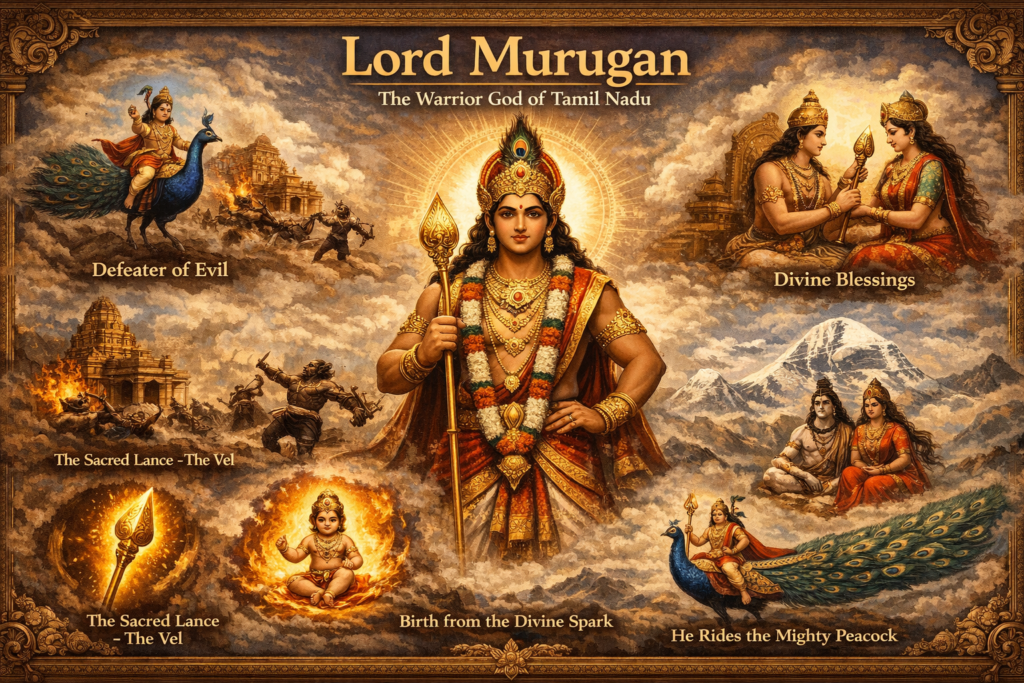
Loudly, the sky thundered, and the battlefield shivered as warriors got ready to fight. In the middle of that, a powerful, bright, young god was standing, holding his divine spear – the Vel. His eyes showed courage and determination. He was not just a warrior. This was Lord Murugan – the son of Lord Shiva, a protector and a symbol of bravery & victory.
But who is this powerful god? Why is he considered a Tamil God? And how is his story still inspiring people today? Let’s get into the deep mythology of Murugan, the warrior god whose story is still living in this century.
Introduction: The Favourite Tamil God
In India’s spiritual world, there are some gods that have been loved deeply and personally as Lord Murugan. If you go and visit the temples of Tamil Nadu, listen to the bhajan or chants during their festivals or the age-old stories by their locals. Then you will clearly feel that Murugan holds a deep place in their hearts, not only a god to them.
The perfect balance of power and wisdom makes him unique. That’s why, with love, people called him the “Tamil God”, because his connection is beyond worship and lives deeply in the hearts as well as the emotions of people.
He is also known as Kartikeya, Skanda or Subramanya – people not only worship him, they feel him. Murugan’s personality holds a special place, as he is a warrier that destroys the evils, a teacher who spreads knowledge, and a wise guide who takes us through the path of truth.
Family, Origin, and Celestial Connections
Kartikeya’s story starts with his divine parents, Lord Shiva and Maa Parvati. Both of them are symbols of deep wisdom and powerful energy, and he was born with both abilities. He is also the younger brother of Lord Ganesha. While Ganpati is the symbol of calmness, wisdom, and removing obstacles, Murugan represents courage and youthful energy.
Together, both brothers make a perfect balance – on one side, there is peace & patience, and on the other hand, there is strength and bravery.
Above the Earth, in the celestial world, Devas once lived in fear. The darkness was spreading, and powerful demons were disturbing the balance of the world. Holding such a powerful energy, Devtas were still helpless, like they were waiting for the leader who would take them to the path of victory.
Then all the surroundings were focused on one young warrior – Lord Murugan. Although he was young, his power and presence were strong, and even the gods could feel it. The Devas didn’t see him as just another god, but as their leader – the one who could guide them in difficult times. With blessings from the heavens and a clear purpose, Murugan stepped forward – not just as the son of Shiva, but as the protector of the celestial world, ready to bring back peace and balance.
The Divine Birth Story
Murugan’s birth was no ordinary event. The birth served as a basic requirement for the universe. The gods lost all their power when the demon Tarakasura reached his almost unbeatable state and started to attack the entire universe. The prophecy stated that only Lord Shiva’s son could defeat the demon.
Shiva’s divine power created fire sparks that exceeded the world’s capacity to contain them. The sacred river Ganga carried these sparks which divine forces used to create the radiant child named Murugan. The birth represented a deeper meaning that divine energy emerges when chaos becomes uncontrollable. Murugan received his creation as a purposeful being who would fight for righteousness while destroying all forms of evil.
Murugan Marriage Story
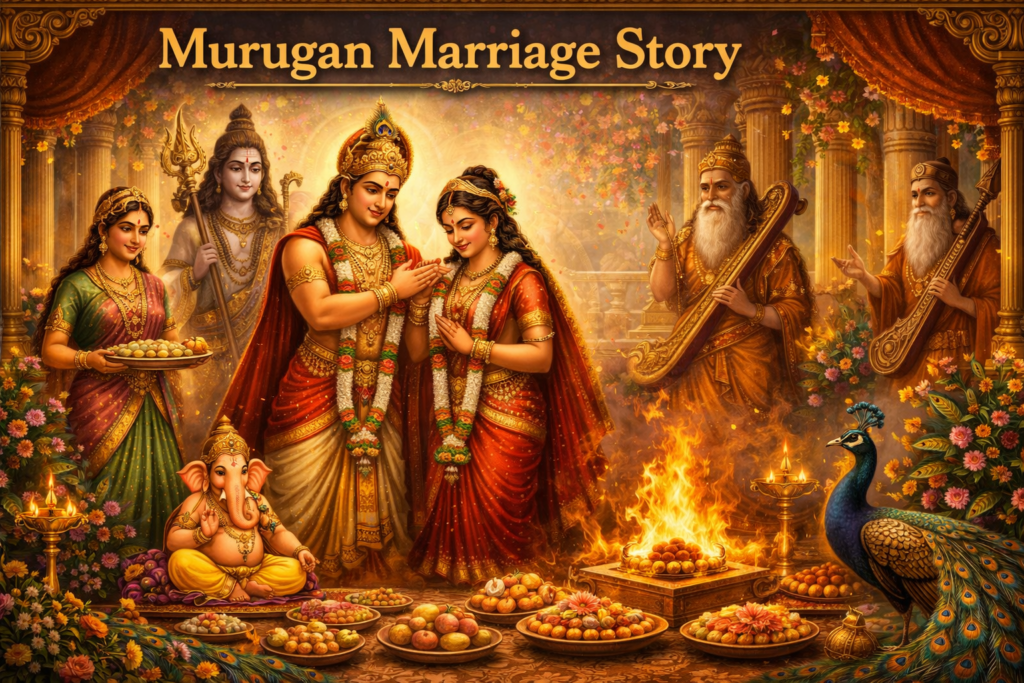
Lord Murugan’s two marriages beautifully reflect two different sides of his personality:
Marriage with Devasena (Celestial Story)
Devasena was the daughter of Indra. After Murugan defeated the demon Tarakasura, Indra offered his daughter’s hand in marriage to him. This marriage symbolizes duty, divine order and responsibility.
Marriage with Valli (A Beautiful Love Story)
Valli was a tribal girl, and her story has a warm, human touch. Murugan did not take a straightforward warrior approach to win her heart. Instead, he appeared in different disguises as an old man, as a hunter and with the help of Ganesha, who disguised himself as an elephant to frighten Valli. In the end, Valli accepted Murugan, and they were married.
Through these two marriages, he teaches us an important lesson that life is about balance. Both duty and love are equally important.
Meaning of the Vel
The Vel serves as the main symbol of Lord Murugan which represents his spiritual power. It is more than a weapon because it serves as a representation of knowledge and power. The wisdom of the Vel cuts through all forms of ignorance, fear and negative situations. Devotees learn from Murugan’s Vel, that true strength comes from both mental clarity and pure thoughts. The tool functions as a weapon which eliminates both external and internal dark forces.
Iconography of Kartikeya
His form contains multiple meanings through its elements which combine to create an entire narrative.
Six faces (Shanmukha) and their meaning: He appears in the Shanmukha form which displays his six facial features that show different personality traits including knowledge, courage, love, power, wisdom and discipline.
Peacock as vahana: Murugan shows his ability to control negative personality traits through his peacock vahana which represents pride and ego.
Rooster symbol on the flag: The flag displays a rooster symbol which represents both alertness and awakening while showing us the path to overcome darkness and ignorance.
Vel and warrior form: He holds the Vel (divine spear) in his hand which symbolises his power to destroy all forms of negative energy. Through his warrior stance and his current form Murugan protects people by showing them that true spiritual development requires both physical strength and mental awareness.
Story of Surapadman
The most popular Lord Murugan story tells about his combat against the demon Surapadman. He had become strong and proud which resulted in him disturbing the heavens while spreading terror among the people. The Devas once again turned to Murugan for help. The battle that followed was intense and filled with powerful energy.
After a fierce battle, the demon King Surapadman took the form of a tree, which Murugan split in two. One half became the rooster, and the other became the peacock, both of which were accepted as loyal followers of the lord. The peacock became his vehicle and the rooster his emblem. This transformation carries a deep message: even negativity can be transformed into something positive through wisdom and compassion.
Other Famous Stories
The Race for the Mango
The special mango served as a fruit of knowledge which Lord Shiva and Goddess Parvati shared with their two sons, Murugan and Ganesha. Shiva presented them with a challenge to determine who would receive the mango. He said, “Whoever goes around the whole world and comes back first will win this mango.”
Murugan immediately flew around the world after he sat on his peacock because he wanted to win the race. His determination made him ready to win the competition with his fast movements. Ganesha followed a different path from others. He chose to remain close to his parents Shiva and Parvati as he walked three times around them. Ganesha explained his reason for being present when he stated, “For me, my parents are my whole world.” The answer which he provided satisfied Shiva and Parvati so they awarded him the mango.
Murugan felt upset when he returned to discover that Ganesha had achieved his goal. The story demonstrates that authentic wisdom requires people to understand what is important instead of pursuing or speeding through their activities.
The Meaning of “Om”
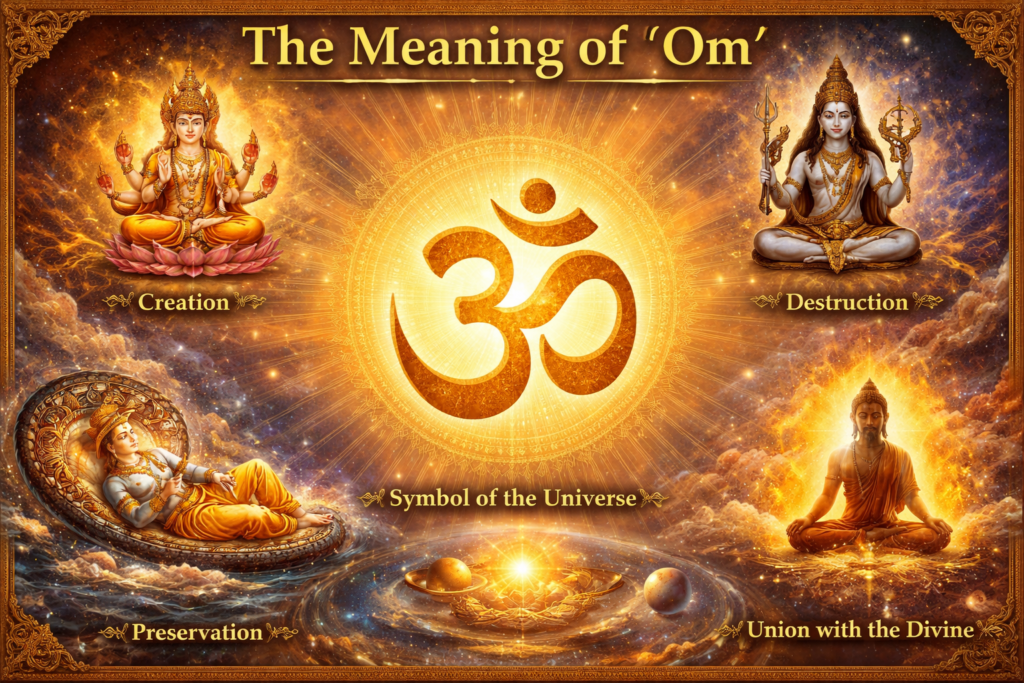
The sacred sound “Om” which represents the universe’s sound was the subject of Lord Shiva’s inquiry to his followers. To everyone’s surprise, it was Lord Murugan who stepped forward to explain it. But he had a condition – he asked Shiva to sit as a student and listen with full attention. Shiva agreed and sat down humbly.
Murugan then explained the deep meaning of “Om” to him with great clarity and wisdom. The moment revealed a powerful truth which demonstrates that all people can learn from others and that wisdom exists in everyone regardless of their age. The scene showed Murugan as more than a warrior because he appeared as a respected teacher and guru.
Lord Murugan and Avvaiyar (The Wisdom Test)
The great poetess Avvaiyar rested under a tree after completing a journey. She possessed wisdom and earned respect, which caused many people to view her as their superior. A tree boy asked her, “Do you want cooked fruits or raw fruits?” Avvaiyar found the question strange but replied, “I want raw fruits.” The boy shook the tree, and some fruits fell down. She blew on the fruits to remove the dust. The boy laughed and asked, “If the fruits are raw, why are you blowing on them?”
Avvaiyar understood that this boy did not belong to this world because he was Lord Murugan who had come to test her intelligence. She smiled and accepted her mistake with humility. The story demonstrates that every person possesses wisdom yet they must continue learning throughout their lives. The path to true knowledge requires humility.
Spiritual Symbolism
The complete fight between wisdom and ego becomes a battle that Lord Murugan handles at his deeper existence. The stories about him demonstrate that people who possess strength but lack humility will experience their own destruction. He embodies the ideal state between strength and gentleness because true leaders possess both powerful qualities and tender qualities.
Murugan’s youthful form indicates energetic forces and pure substances, and the start of fresh possibilities. He guides his followers to search their inner worlds so they can defeat their inner obstacles and achieve their complete self-development.
Six Abodes (Arupadai Veedu)
Murugan’s presence is strongly felt through his six sacred temples, known as the Arupadai Veedu. Each temple represents a stage in his divine journey. These are:
1. Tirupparankunram
After Lord Murugan defeated the demon Surapadman, he brought peace to the celestial world which made the Devas very grateful. The celebration required them to honor their happiness by arranging Murugan’s marriage to Devasena, who served as Indra’s daughter, at Tirupparankunram. This location stands as a victorious moment which shows the divine union between Murugan and his role as the Devas’ guardian.
2. Tiruchendur
This location serves as the battlefield where Lord Murugan faced the formidable demon Surapadman. The battle continued for a long period but Murugan eventually defeated his opponent by using his Vel weapon. He chose to transform his opponent into a peacock and rooster instead of killing him entirely. This location demonstrates that good triumphs over evil while showing people how to turn negative things into positive outcomes.
3. Palani
This location connects to the well-known mango tale. Lord Murugan left his home after he lost the race to Lord Ganesha because he felt emotional pain. He went to Palani and decided to live there in tranquil isolation from his previous life. His parents later visited him and explained that “You yourself are the real fruit (knowledge).” This location shows that people need to detach themselves from their possessions to achieve self-realization, which leads to inner happiness.
4. Swamimalai
At Swamimalai, something very special happened. Lord Murugan became a guru (teacher) at this location where he taught his father, Lord Shiva, the meaning of “Om.” This location shows that true knowledge exists beyond age and position because even a child can teach others.
5. Thiruthani
Murugan arrived at Thiruthani after fighting numerous battles to defeat evil because he wanted to achieve tranquility. He rested at this location to escape from the fighting and the violent emotions. This location represents the state of peace which people achieve after they handle their internal conflicts.
6. Pazhamudircholai
The location connects Valli’s romantic tale with the narrative of Avvaiyar. Murugan used this location to evaluate Avvaiyar’s intelligence while also displaying his joyful affection for Valli. The location shows three values which include love and humility and learning.
Pilgrims who come to these temples will experience a spiritual change because they progress toward inner development. Each residence delivers a narrative that teaches a lesson, story and deepens the devotion.
Major Festivals of Murugan
His festivals display lively celebrations which show deep religious devotion.
Thaipusam is one of the most intense festivals during which devotees carry Kavadi as an expression of their faith and total dedication.
Skanda Shashti commemorates his victory over Surapadman which serves as a reminder to devotees about the triumph of goodness over evil.
Panguni Uthiram celebrates his divine weddings, while Vaikasi Visakam commemorates his birth.
The festivals serve as more than simple rituals because they create shared emotional experiences which enable communities to unite.
Murugan’s Favourite Flowers & Colours
He is frequently connected to vibrant colours, which include red, yellow and orange because these hues represent his powerful energy, valiant nature and his positive character. Devotees present flowers such as jasmine, lotus and marigold because each flower has its own religious significance. The offerings serve a decorative purpose but also symbolize the three elements: love, devotion and total submission to God.
The Method of Worship
The act of worshipping Lord Murugan requires simple rituals that lead to profound spiritual experiences. Devotees start their home worship by placing a Murugan idol or photo within an area that maintains both cleanliness and tranquility. This space transforms into a holy area where people can sit down and pray while experiencing a spiritual connection. The next step involves lighting a diya which brings positive energy and peacefulness to the environment.
People then offer fruits, milk, flowers, and sometimes sandalwood paste as a sign of respect and love. Many people chant “Om Saravana Bhava” during this activity because they believe it brings them power, peace and mental clarity. The process of worshiping in temples involves more complex rituals. Priests create a holy environment through their ceremonial practices which include using sacred ash, flowers and playing music.
How to Receive Blessings from Him
The process of receiving Murugan’s blessings requires people to practice their faith through genuine devotion instead of performing elaborate sacred ceremonies. Devotees believe that discipline, humility, and faith open the path to his grace. Visiting temples, fasting, and keeping a pure heart enable people to establish a strong connection with him. The most important aspect of devotion exists within a person’s inner self.
Interesting Fact: The World’s Tallest Statue of Lord Murugan
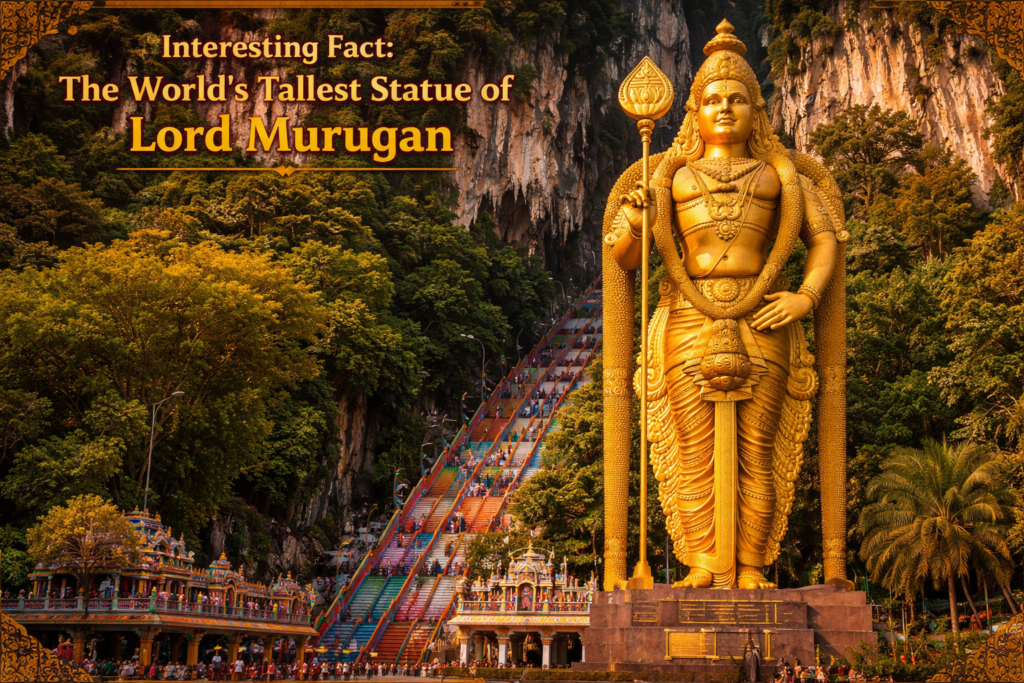
The Batu Caves in Malaysia feature a massive statue which represents one of the most interesting aspects of Lord Murugan. The golden statue which stands at the cave entrance provides an instant attraction which creates an atmosphere of awe and devotion among visitors. The statue ranks among the tallest Hindu deity statues worldwide because it represents Murugan through his strength and protective abilities.
Thousands of devotees and tourists visit the location every year because the Thaipusam festival creates a major spiritual center which exists outside of India. The colorful steps which ascend toward the caves create a special experience for devotees who climb them with their religious commitment. The entire place feels alive with energy, prayers, and devotion.
Conclusion
Lord Murugan exists as an everlasting entity who embodies three roles: his military defence of his people, his educational role as a teacher, and his representation of wisdom, which he uses to inspire others.
His stories, symbols and teachings uphold their power to create spiritual transformations for numerous people. The current fast-paced society uses his teachings to show that people should practice these four values: strength, humility, wisdom-seeking and following the path of truth.