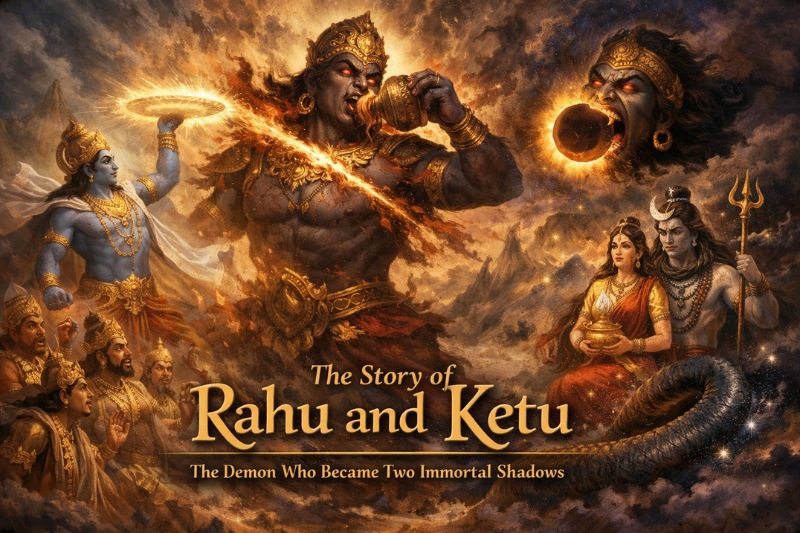
What would happen if one act of lying could change the fate of the cosmos forever? The ancient story of Rahu and Ketu describes how a demon attempted to deceive the gods and take their immortal nectar. The demon received a special punishment which split his body into two eternal shadows that would forever roam the universe.
This story will present the entire narrative about Rahu and Ketu which includes their origins, their betrayal and their evolution into strong celestial entities. The study will examine their astrological importance, which affects human life.
Introduction: The Churning of the Cosmic Ocean
Long, long ago, before the world as we know it had found its shape, the gods and demons came together for one single purpose. The Devas needed Amrit because Sage Durvasa had cursed them to lose their powers and eternal life. The cosmic ocean known as Kshir Sagar had the nectar at its lowest point. The gods required assistance to complete their task of churning the ocean.
The Asuras and the gods established their agreement to churn the great cosmic ocean (Samudra Manthan) and divide the resulting nectar between themselves. Both sides agreed. They used Mount Meru as the churning rod and the great serpent Vasuki as the rope. The Devas pulled from one side while Asuras pulled from the opposite side. The churning process started.
The ocean started to rotate while it produced a loud noise. The ocean released various substances which included poisonous materials, divine horses, the goddess Lakshmi, the moon and finally a divine being who carried a golden pot. The Amrit existed inside that pot. Our story begins at this point.
A Demon Among Gods
The great churning created multiple threats which reached their first dangerous moment. Halahala poison emerged from the ocean before the first nectar appeared. Its dangerous fumes started to spread throughout the universe which resulted in a threat to all living things.
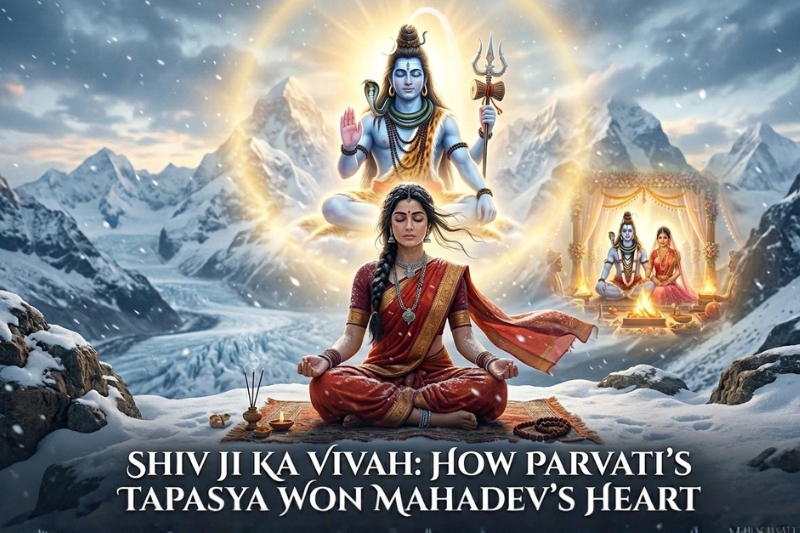
The Devas and Asuras both experienced terror which led them to request assistance from Lord Shiva. Mahadeva made the choice to drink the poison because he wanted to protect the universe. The Goddess Parvati used her grip on his throat to stop the poison from reaching his body. His throat remained in that position which resulted in blue coloring that gave him the name Neelkanth.
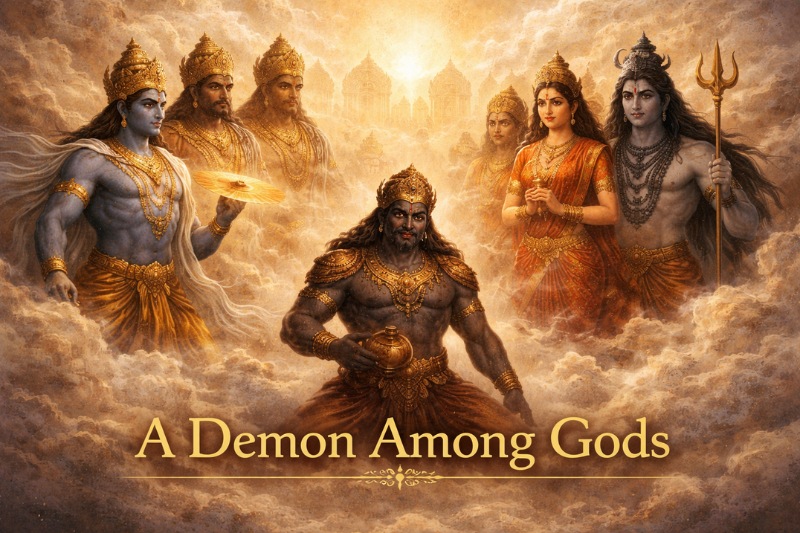
The churning process resumed after the crisis ended which resulted in the appearance of Amrit. Disorder broke out once again. The Asuras took control of the nectar and refused to share it. The Devas observed everything as they watched their chance to gain eternal life vanish. Lord Vishnu appeared at that specific point. He transformed into Mohini who possessed extraordinary beauty. The Asuras became entranced by her because they believed she would share the Amrit with them. Mohini began serving — but cleverly gave it only to the gods, keeping the demons distracted.
Among the Asuras, however, one was more observant — Svarbhanu. He saw through their scheme which led him to dress as a Deva and sit between Surya and Chandra. His plan achieved temporary success. Mohini unknowingly served him the amrit, and he swallowed it.
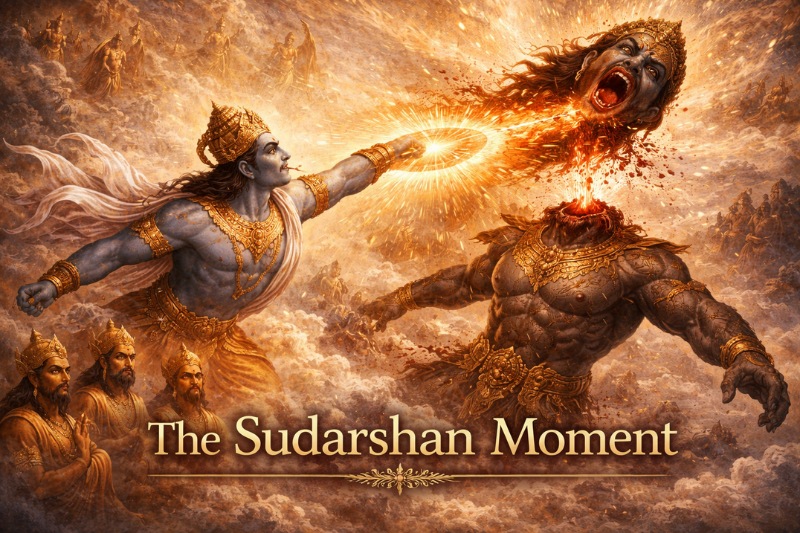
The Sudarshan Moment
Surya and Chandra demonstrated exceptional vision which enabled them to see the demon who sat between them. This was no god — this was Svarbhanu in disguise. They immediately alerted Lord Vishnu. Vishnu dropped the Mohini form instantaneously. His eyes became intense. He raised his divine weapon which was the Sudarshan Chakra a spinning disc of blazing light.
With one powerful throw he cut off the demon’s head from his body. But the Amrit had already been swallowed. The demon’s body became immortal because of the spilled drops. The cut could not kill him because he remained alive in every moment. The head and body created two living beings which could not die.
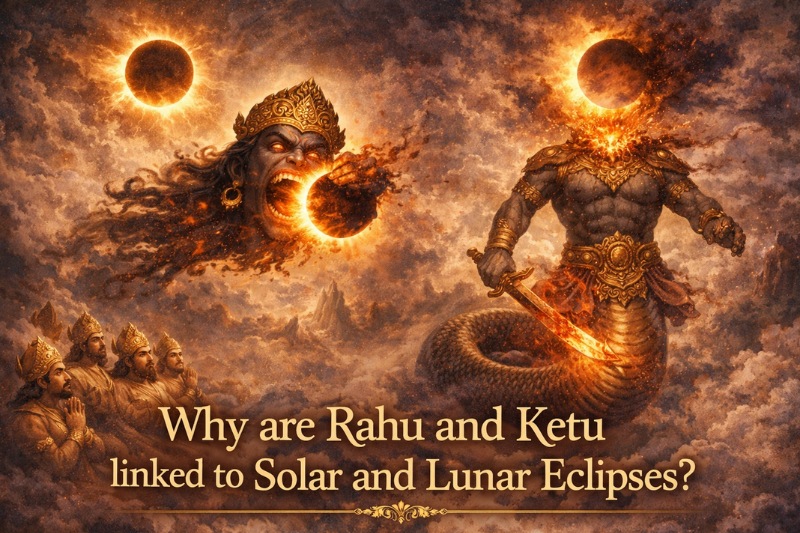
The head transformed into Rahu while the body turned into Ketu. Both Rahu and Ketu have held a grudge against Surya and Chandra since that day because these two caught them. The ancient texts explain that the grudge continues to display itself in the sky whenever an eclipse occurs.
The Birth of Rahu and Ketu
The Amrit he consumed granted him eternal life. His body transformed into two parts, with his head becoming Rahu and his body becoming Ketu. After this event, Lord Brahma established Rahu and Ketu as members of the Navagrahas which consists of nine celestial bodies that control human destiny within Hindu astrology. This was not a reward for the demon’s trickery.
The statement acknowledged that universal existence requires the presence of opposing forces. The gods needed these two shadow planets to maintain cosmic balance. Rahu received control over the north lunar node which marks the point where the Moon ascends through the Sun’s path. Ketu received control over the south lunar node which serves as the descending crossing point.
These are not physical planets like Mars or Saturn. The entities remain invisible as shadowlike forms which Hindu thought considers to possess immense power.
Why are Rahu and Ketu linked to Solar and Lunar Eclipses?
The mythology includes its most beautiful section because it links the narrative to celestial events which people could observe in the sky. Ancient people witnessed an eclipse and asked about the Sun’s disappearance and the Moon’s transformation into a dark red color. Hindu mythology provided its solution.
A solar eclipse occurs when the Moon blocks the Sun’s light from reaching Earth. In mythology, this is Rahu swallowing the Sun. A lunar eclipse occurs when Earth’s shadow moves across the Moon, causing the Moon to appear red. In mythology, this is Rahu (or sometimes Ketu) swallowing the Moon. The demon’s rage was displayed in the sky because people believed the blood-red Moon during a lunar eclipse showed his anger.
Scientific Connection
Here is the fascinating part – ancient Indian astronomers actually understood the geometry of eclipses very well. The Surya Siddhanta, one of the oldest astronomical texts, accurately describes how lunar nodes cause eclipses. The mythological Rahu and Ketu were poetic names for the north and south lunar nodes — the exact mathematical points where the Sun’s path and Moon’s path intersect. The Moon can only cause an eclipse when it is positioned close to these nodes.
Rahu Cultural Practices (During the Grahan)
People in India continue to observe eclipses with serious dedication which they maintained throughout history. People avoid eating food during an eclipse. They take baths after it ends. Temples stop their operations. Pregnant women should remain inside their homes according to medical guidelines.
People chant mantras and pray for the Sun or Moon to be freed from Rahu’s grasp. These practices come straight from this ancient story — the belief that a demon is active in the sky, and that prayers and purity can help the light return faster.
Rahu and Ketu in Temples – Their Iconography
Rahu and Ketu appear at Navagraha shrines in Indian temples together with Saturn, Jupiter and Mars. The two elements create a distinct appearance which generates a strong, dark and mysterious effect.
Rahu: The Head
Rahu exists as a head which has been cut off from its body. His expression shows fierce strength because he has wide-open eyes and an open mouth which shows his permanent hunger. He appears in black and smoky grey tones while he rides a chariot which is drawn by black horses. Rahu represents people who follow their desires for power and material possessions without any boundaries through his association with ambition and illusion.
Ketu: The Tail
Ketu appears as a headless body which typically shows a serpent or flame instead of a head. His form shows a state of unlinking from the material world. Ketu helps people achieve spiritual freedom through his ability to provide inner wisdom which enables them to break free from their material ties developed through past life karma.
Symbolism in Hindu Thought
Rahu and Ketu exist as mythological entities who display their power through their impact on human existence. Rahu represents human desire and ambition which leads people to seek perpetual power, success and public recognition. Ketu represents the ability to detach from material possessions while achieving spiritual advancement and understanding of their temporary nature.
The two elements together show how people need to achieve equilibrium between pursuing worldly things and releasing their attachment to them. That is why, despite their origin, they are worshipped, not as evil, but as forces of transformation.
Rahu and Ketu in Astrology
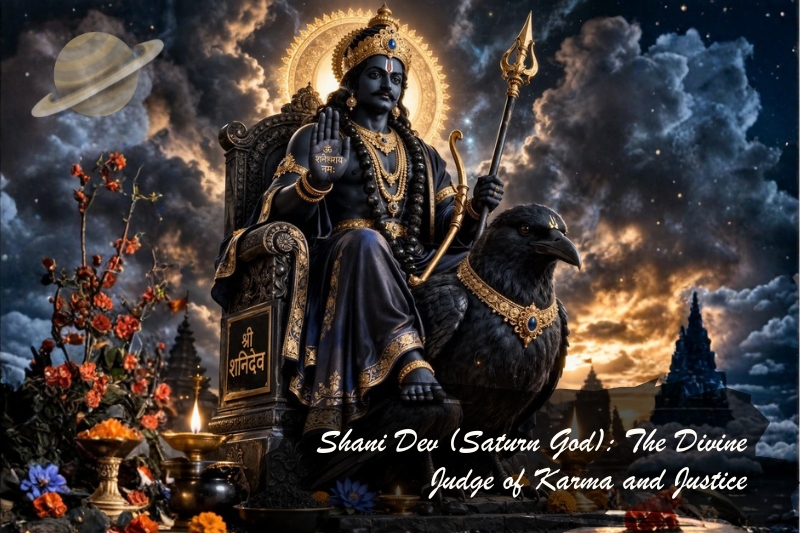
The system of Vedic astrology includes Rahu and Ketu as two of its nine celestial bodies which represent the two lunar nodes. The two celestial bodies need 18 months to pass through all zodiac signs which results in an 18-year cycle that connects to significant life transitions. Rahu governs desire, ambition, illusion, and sudden rise or confusion. While Ketu governs spirituality, detachment, past karma, and inner transformation.
The placement of them in a person’s birth chart reveals their life purpose through their essential desires and essential needs to let go of particular things. The 18-year Mahadasha of Rahu brings about transformation through its external power and ambitious desires which create unpredictable results. Ketu’s 7-year Mahadasha leads to introspection, detachment, and spiritual growth.
Rituals and Beliefs
People worship Rahu and Ketu to achieve balance and receive protection.
- Rahu Kaal: It’s a period that lasts for 90 minutes every day, and people consider it an inauspicious time to begin new tasks.
- Rahu remedies: Require people to offer black sesame and coconut and perform prayers.
- Ketu remedies: Lighting oil lamps, chanting mantras like Om Ketave Namah.
Eclipses provide the time for special prayers and mantras because that moment marks their strongest influence.
Lessons from the Story
The story presents important lessons about life.
- The human mind seeks things which it cannot possess but which it knows will bring it harm.
- The pursuit of falsehoods may bring temporary success to people but it will create permanent difficulties.
- Both shadow forces and challenges present their own ways to assist human development.
- Human existence needs the combined forces of Rahu which brings ambition and Ketu which demands detachment.
- Everything exists in a cycle because all things will eventually cease to exist.
Conclusion
The original entity of Rahu and Ketu transformed into two everlasting forces which influenced the development of mythology, astrology and human understanding. Their Divine Story reminds us that life is a balance of opposites — desire and detachment, illusion and truth. Even what seems broken or dark has meaning. The Sun’s darkening and the Moon’s red transformation create the impression that two shadows continue to traverse the sky, which shows that everything in existence contains both good and bad elements. Everything in existence occupies its designated area.