What if beauty was never meant to be just seen, but felt as a power?
Sanatan Dharma defines beauty as something that extends beyond physical attractiveness. The energy form known as Shakti functions as a cosmic force that generates and sustains all existence while transforming creation. The existence of Maa Lalita Tripura Sundari proves this fundamental truth.
Introduction
The Maa Lalita Tripura Sundari embodies more than her role as a beauty goddess. She represents ultimate strength, which she shares with her divine knowledge and ability to maintain complete equilibrium. Her story exists beyond mythology because it shows people how to achieve harmony and experience inner awakening through a better understanding of consciousness. Also holds a special position in spiritual traditions because she appears in sacred texts like the Lalita Sahasranama and the Brahmanda Purana.
The blog investigates her divine narrative while providing an analysis of her deeper symbolic representation and the spiritual knowledge that still leads modern seekers to enlightenment.
Who is Maa Lalita Tripura Sundari?
The meaning of her name carries significant importance.
“Lalita” means the divine mother who embodies playful, gentle and graceful qualities.
“Tripura” refers to the queen who rules all three domains, which include the material, cosmic and creative.
“Sundari” is beauty, which exists in its most authentic state beyond all physical attributes.
The Supreme form of the Divine Mother exists through Maa Lalita Tripura Sundari as Adi Parashakti. She combines her gentle nature with her strong abilities to provide care while using her fierce side when necessary. The Dasha Mahavidyas, which constitute the ten wisdom goddesses, include her as a member who demonstrates advanced spiritual knowledge.
Her presence reminds us that true power exists within us and does not need aggression because it manifests through graceful awareness and self-control. Maa Lalita Tripura Sundari is known by other divine names, which include Lalita Rajarajeshwari, Shodashi, Kameshwari and Sri Mata. Each name describes a different aspect of her divine Shakti.
From Cosmic Birth to the Fall of Bhandasura
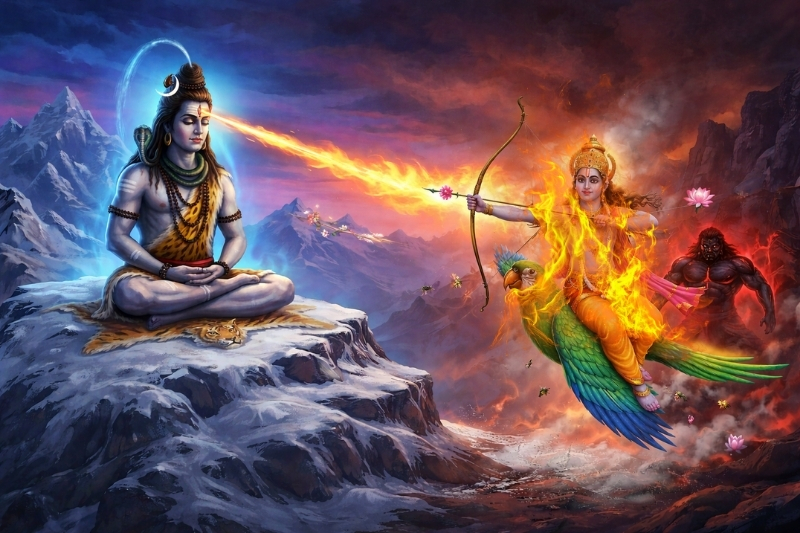
The story begins with a moment of imbalance. The gods required Lord Shiva to end his deep meditation because they needed him to restore balance to the universe which established the need for Kamadeva to awaken him from his meditation. With his flower arrow of love Kamadeva attempted to wake Shiva from his meditation state by shooting it at him to create a desire which would make him leave his meditation state.
Shiva became angry when someone interrupted his meditation so he used his third eye to turn Kamadeva into ashes. The ashes from that event produced something unexpected which became a strong demon named Bhandasura.
Bhandasura achieved great power through his intense penance practices. His growing power transformed into arrogant behaviour. He defeated the gods and established his control over the heavens while he spread destruction throughout the entire universe. Everywhere fear began to spread because Dharma had become weaker. The gods who found themselves in a desperate situation turned to Indra who guided them toward a more profound resolution.
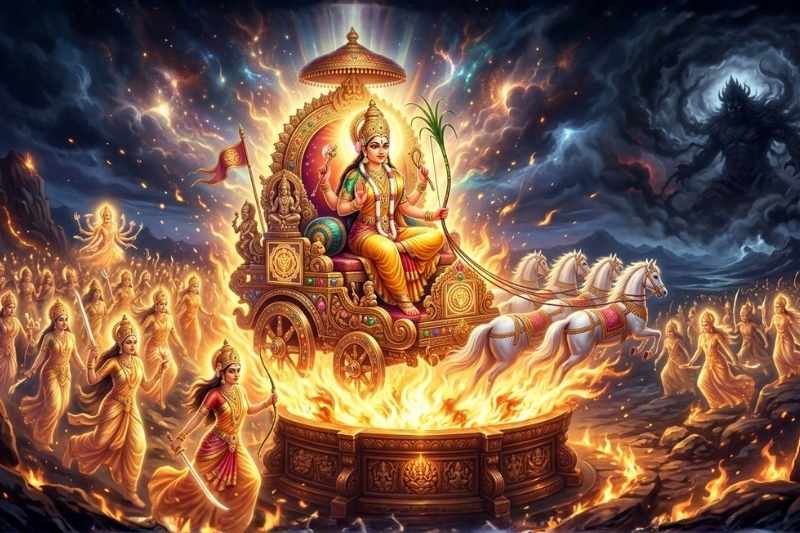
Indra did extensive penance in the Himalayas to request help from the divine. The gods performed a holy yajna with their complete devotion, which included a sacred fire ritual. From the flames of the Chidagni Kunda, a divine form emerged.
The Divine Emergence of Maa Lalita
Maa Lalita Tripura Sundari appeared – radiant, calm, and extraordinarily beautiful, yet carrying unimaginable Shakti. The purpose of her birth was to establish balance while terminating all evil. She was seated on the magnificent Chakra Raja Ratha, her celestial chariot, and was surrounded by a powerful divine army created through her own energy.
The Great Battle
The battle between Maa Lalita Tripura Sundari and Bhandasura was not just a war of weapons, but a clash between awareness and ignorance. She used her divine strength together with her precise and graceful movements to defeat Bhandasura while destroying his entire army. The universe returned to harmony, and the gods were freed from fear. But this story carries a deeper meaning.
Bhandasura represents ego, illusion, and uncontrolled desires. Maa Lalita represents inner awareness, discipline, and divine Shakti. Her victory reminds us that true power lies in conquering what is within.
The Symbolism of Her Form
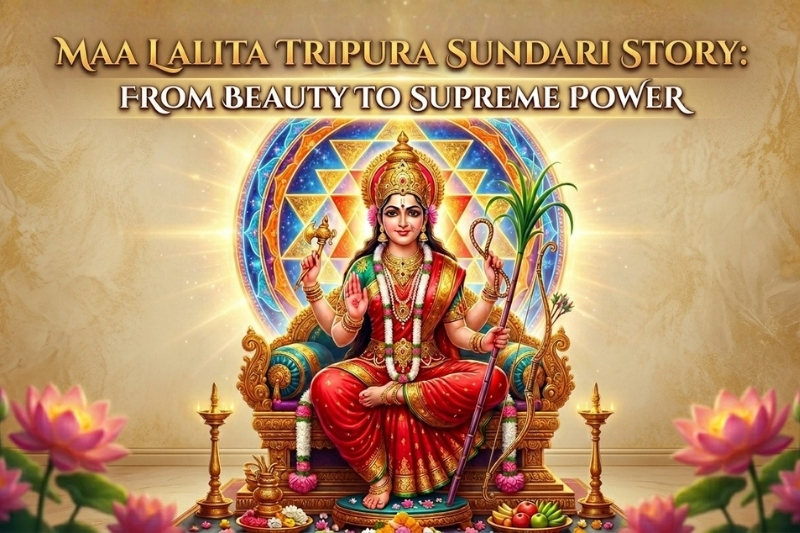
Every aspect of Maa Lalita Tripura Sundari’s physical existence carries sacred spiritual significance. Her sugarcane bow represents the human mind, which operates with both sweet and restless qualities. The flower arrows she uses to represent the five senses show their continuous behavior of drawing our attention toward what lies outside ourselves. The noose (Pasha) signifies attachment, while the goad (Ankusha) represents control and discipline.
Her facial expression shows her real strength which extends beyond her present physical form. Maa Lalita displays her inner power through her peaceful facial expression which reflects her deep compassion for all people.
This state shows total balance, which exists without any indication of aggression or violent emotions. The statement shows that true Shakti power originates from inner peace, instead of violent methods. She teaches us that life is not about suppressing the mind or senses, but about understanding and mastering them. The goal requires individuals to maintain their central position while facing all worldly challenges.
The Spiritual Meaning of “Tripura”
The term “Tripura” extends beyond the boundaries of material existence. It represents three distinct states of existence, which include body, mind and soul. The system demonstrates three different states of awareness, which include waking, dreaming and deep sleep.
Maa Lalita Tripura Sundari governs all these dimensions, yet she also exists beyond them. She possesses the ultimate level of awareness which enables her to see all things without being affected by them. The concept helps us understand that divinity exists within our own consciousness rather than outside of us.
Lalita Sahasranama: The Thousand Names of the Divine
The Lalita Sahasranama functions as a sacred stotra (hymn) that contains 1000 names that describe Maa Lalita Tripura Sundari, who represents the ultimate form of the Divine Mother as per Shakti tradition. She possesses beauty, power, compassion and cosmic abilities which exist throughout the universe according to her various names.
The Brahmanda Purana contains the text that presents a conversation between Sage Agastya and Lord Hayagriva about the material. The text functions as an important resource that guides devotees who perform Sri Vidya worship.
Deeper Meaning & Importance
- The name serves as a title that functions as a mantra because it contains a particular sound pattern that produces spiritual power through its pronunciation.
- The 1000 names together describe advanced understanding about the universe, human consciousness and the divine feminine principle of Shakti.
- Sri Chakra worship practice establishes a connection to a sacred structure that shows both the cosmic universe and human spiritual development.
- The process of chanting this text brings equivalent benefits to conducting traditional religious ceremonies, which include puja.
The process of listening to recitations or reading what they produce will establish mental peace while creating better focus, which handles all fear, confusion and anxiety symptoms. The process provides protection against negative energies while enabling spiritual development and mental peace.
Best way to practice this:
- Chanting the text should occur during morning hours and evening hours.
- The act of listening with focus and devotion provides listeners with better results.
- Often recited during Fridays, Navratri, or special puja rituals.
- Can be combined with meditation for a deeper inner connection.
- The process of listening with devotion or chanting a few names will bring positive effects, even if one cannot chant all 1000 names.
Shri Chakra & Sri Vidya: The Sacred Geometry of Maa Lalita
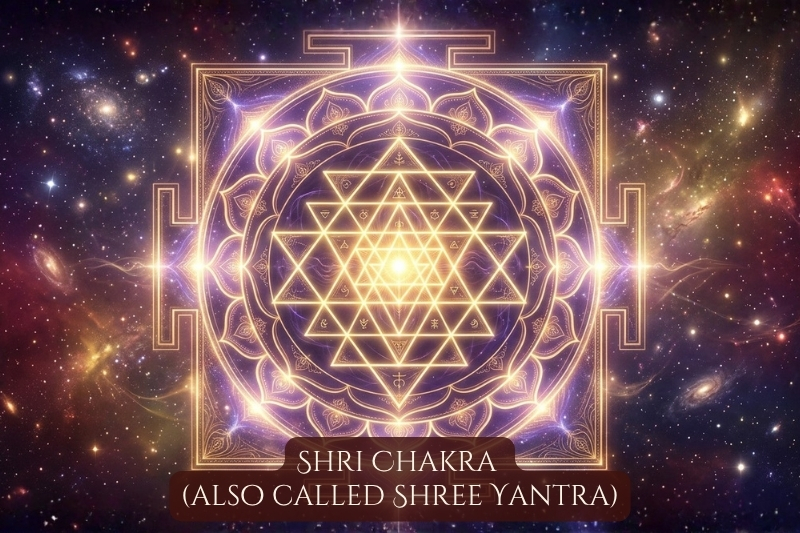
Shri Chakra (also called Shree Yantra)
This sacred geometric diagram is an effective worship tool for the supreme Maa Lalita Tripura Sundari. It is often regarded as one of the most important symbols in the Shakta tradition. The Maa Lalita Tripura Sundari occupies this place as her divine sacred space. The entire universe, together with its cosmic energy, exists through this representation. The system provides both outer space and inner personal mapping through its design.
The structure consists of intersecting triangles, which create a design system where upward triangles depict Shiva as consciousness, while downward triangles depict Shakti as energy. The triangles develop a sophisticated pattern that represents the equilibrium and connection of all things. The design features lotus petals which surround the central area, together with outer squares that depict different stages of existence and spiritual growth.
The Bindu (Centre Point)
The Bindu serves as the central point that defines the Shri Chakra. The point marks the beginning of existence from which all things come into being. The symbol represents the highest truth, which embodies pure awareness and the combined existence of Shiva and Shakti.
Sri Vidya
The spiritual path of Sri Vidya provides a worship system that enables devotees to honour Maa Lalita Tripura Sundari. The practice involves deep meditation, which uses mantras and rituals together with visualisation to achieve an understanding of the universal connection between individual souls. The practitioners use the Shri Chakra as their meditation tool to establish a direct link with the divine.
The sacred diagram of Shri Chakra contains all cosmic existence within its geometric design. It reflects both macrocosm (universe) and microcosm (human consciousness). Meditating on the object leads to a personal transformation that takes the practitioner from exterior existence to inner knowledge until they reach Bindu, which represents absolute truth.
Worship and Spiritual Practices
The worship of the Divine Mother – Maa Lalita Tripura Sundari exists as a straightforward practice that holds great spiritual significance. The practice enables people to connect with the divine through chanting mantras and performing small worship rituals that include offering flowers and lighting a diya and incense and reciting or listening to Lalita Sahasranama and meditating on her divine form as Maa Lalita Tripura Sundari.
These practices can be perform at home because they require only a devoted person to maintain a tidy and peaceful area. People need to understand that intention serves as the most critical factor because sincere emotional expression matters more than obtaining absolute perfection through strict rules.
The daily practice of meditation for a minimum duration of five minutes enables all people to attain mental tranquility which allows them to connect spiritually with their inner selves. The Brahma Muhurta period of early morning provides the best time for meditation, which people can practice during any silent time that helps them concentrate their minds and achieve inner calm.
Temples and Festivals Dedicated to Maa Lalita Tripura Sundari
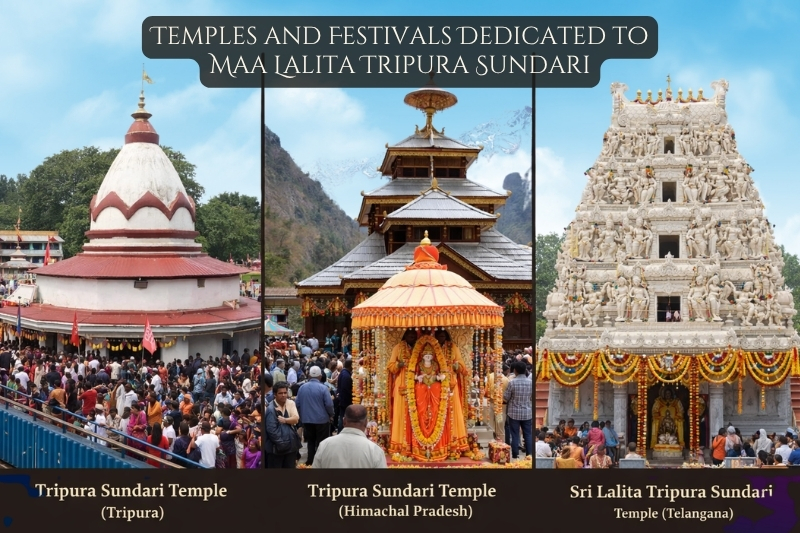
Maa Lalita Tripura Sundari receives worship at various holy places throughout India, but certain temples possess greater religious importance.
Famous Temples & Stories:
- The Tripura Sundari Temple (Tripura) exists as an ancient religious site because it belongs to the 51 Shakti Peethas which contains a sacred spot where part of Goddess Sati’s right foot is said to have fallen. After the Goddess appeared to him in a dream, Maharaja Dhanya Manikya built the temple in 1501 CE at her command to establish her shrine on a hillock shaped like a tortoise. The temple worships Goddess Lalita as Tripura Sundari, and a Diwali fair takes place there, which attracts lakhs of devotees who visit each year.
- Tripura Sundari Temple (Himachal Pradesh):Located within the foothills of the Himalayas, this temple is a sacred site with a space dedicated to the Maa Lalita Tripura Sundari, who belongs to the Sri Vidya tradition. Local mythology holds that it was founded by great sages, as well as devotees of tantra. Festivals including Navratri and full-moon recitations of Lalita Sahasranama, are celebrated here.
- Sri Maa Lalita Tripura Sundari Temple (Telangana):Serves as a fierce temple in Southern India where worshippers pray to the Goddess, situating her as her highest form of feminine divine energy. The temple celebrates Lalita Panchami with special rituals that people do religiously.
People celebrate Navratri through nine nights of religious observance which they use to honour the Divine Feminine. Also, the Lalita Jayanti festival takes place during the Magha month which falls between the time frame of January and February, because people conduct prayers and make offerings to the Maa Lalita Tripura Sundari.
The devotees worship her at the temples and celebrations as the ultimate representation of feminine energy, who showcases beauty, power, protection and spiritual grace. The temple attracts devotees from both India and foreign countries who wish to experience its sacred atmosphere.
The Lessons We Learn From Maa Lalita
The holy teachings of Maa Lalita Tripura Sundari provide profound spiritual wisdom and essential life teachings. She shows people how to train their mental and sensory abilities which helps them make conscious choices instead of acting on their immediate impulses.
Her personality shows complete equilibrium between gentleness and power because she demonstrates how empathy and strength can unite in peaceful coexistence. The story of Bhandasura shows that spiritual development requires people to defeat their ego, together with their inner darkness. She teaches us that all humans possess divine energy, which requires only our devotion, discipline, and righteous actions to awaken it.
Conclusion
Maa Lalita Tripura Sundari leads us through a path which begins with our experience of grace, beauty and ends with our understanding of supreme Shakti. She exists as the universal force which creates, protects and changes all things rather than existing only as a deity whom people worship.
Maa Lalita Tripura Sundari stories and teachings show us that every person possesses this divine power, which only requires devotion, awareness, and righteous living to become active. The Divine Mother exists in all of us, which creates a peaceful light that guides us through life, according to her gentle power.